



From Sugarcane to Sweetener
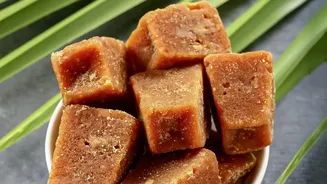
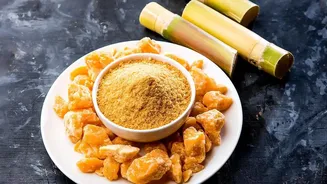
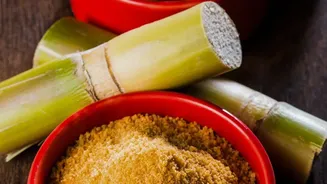
Both jaggery and white sugar begin their journey as sugarcane juice. Their paths diverge in the processing. To make jaggery, the juice is simply boiled in large, open pans until it thickens and solidifies. This minimal processing means it retains the molasses,
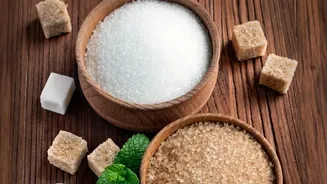
which gives jaggery its characteristic brown colour and rich, caramel-like flavour. White sugar, on the other hand, undergoes extensive industrial refining. The process involves clarification, crystallisation, and centrifugation to strip away the molasses entirely, resulting in pure, white sucrose crystals with a neutral sweet taste.
A Look at the Nutritional Facts
The main difference in their nutritional profiles comes from the molasses that jaggery retains. While white sugar is around 99.7% sucrose and offers what are often called 'empty calories', jaggery contains slightly less sucrose (around 65-85%) and holds onto trace amounts of minerals. These include iron, magnesium, potassium, and calcium. However, the praise for jaggery's mineral content needs context. While it is genuinely more nutritious per gram, the amounts are small in typical serving sizes. A 10-gram piece of jaggery provides only a small fraction of your daily mineral needs, and you would have to consume a huge, unhealthy amount of it to get significant benefits.
Calories and Blood Sugar Impact
When it comes to calories, the difference is negligible. 100 grams of jaggery contains about 383 calories, while the same amount of white sugar has around 387 calories. Switching from sugar to jaggery will not make a meaningful difference to your calorie intake. A more surprising fact is their effect on blood sugar. Many believe jaggery is gentler on blood sugar levels, but several studies show the opposite. Sugarcane jaggery has a high Glycemic Index (GI) of around 84, which is actually higher than that of white sugar (around 65). This means sugarcane jaggery can cause a faster and sharper spike in blood glucose, a crucial fact for people with diabetes or insulin resistance to consider. Both are high-GI foods and should be consumed with caution.
The Winter Wellness Connection
So why is jaggery a winter staple in India? Traditional wisdom and Ayurveda consider jaggery a 'warming' food, ideal for colder months. This warming effect is partly due to its high calorific value, which provides the body with energy to stay warm. It is also traditionally used as a remedy for cold and cough, as it is believed to help clear the respiratory tract. Culturally, jaggery is deeply woven into winter cuisine, binding together ingredients like sesame seeds ('til'), peanuts, and ghee in treats like 'chikki' and 'laddoo'.
The Verdict: Is Jaggery Really Better?
Jaggery is marginally superior to white sugar, but it is not the guilt-free health food it's often made out to be. Its main advantages are that it's less processed and contains trace minerals like iron. However, its high calorie count is almost identical to sugar's, and its impact on blood sugar can be even more pronounced. The most important takeaway, as the headline suggests, is that both are forms of sugar and contribute to your daily energy intake. Excessive consumption of either can contribute to health issues like weight gain and other problems associated with high sugar intake.