




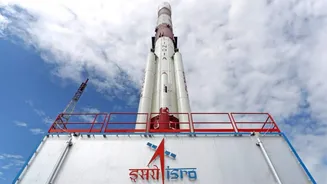
The Promise and Peril of Launch
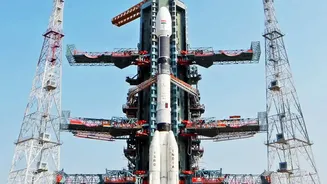
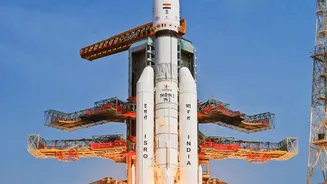
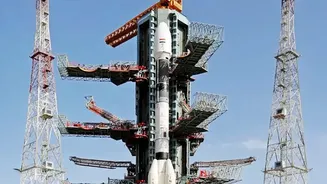
The Gaganyaan mission represents a monumental leap for India, aiming to send a three-member crew into a 400 km orbit and bring them safely back to Earth. This achievement will place India in an elite club of nations with independent human spaceflight
capabilities. However, the journey to space is fraught with risk, especially during the initial ascent. The launch phase is the most dangerous part of any space mission, where the launch vehicle is under immense stress, accelerating to hypersonic speeds while battling Earth's gravity and atmospheric pressure. The powerful solid-fuel boosters used on the LVM3 rocket, once ignited, cannot be shut down, meaning any major malfunction could escalate in seconds. This is where mission success takes a backseat to the number one priority: crew survival.
An Ejection Seat for a Spaceship
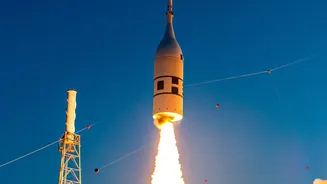
Enter the Crew Escape System (CES). In simple terms, it's a powerful, rocket-powered safety mechanism designed to pull the crew capsule and its occupants away from a failing launch vehicle. Unlike an ejection seat in a fighter jet that saves the pilot, the CES saves the entire capsule. This system can be activated automatically within milliseconds of a detected anomaly or manually by the crew or ground control. Whether on the launchpad before liftoff or during the ascent through the atmosphere, the CES is the astronauts' ultimate lifeline, a purpose-built system that only fires when things go catastrophically wrong.
How ISRO's System Works
ISRO has engineered a 'puller' type system, which consists of a tower mounted on top of the Gaganyaan crew module. This tower is packed with a set of quick-acting, high-energy solid-propellant motors. In an emergency, these motors fire with immense force, generating an acceleration that can be up to 10 times that of gravity to rapidly yank the crew module away from the exploding or out-of-control rocket. The Integrated Vehicle Health Management system, a complex network of sensors, acts as the brain, constantly monitoring the rocket's vital signs and ready to trigger the abort sequence instantly. Once the module is at a safe distance, the escape tower is jettisoned, and a series of parachutes deploys to slow the capsule for a safe splashdown in the sea.
Tested, and Tested Again
A system this critical cannot be based on theory alone. ISRO has undertaken a series of rigorous tests to validate every component and sequence of the CES. This began with a successful Pad Abort Test in 2018, where the system was fired from the ground to simulate a launchpad emergency. More recently, ISRO has used a specially designed Test Vehicle to simulate in-flight emergencies. The TV-D1 mission in October 2023 successfully demonstrated an abort at a critical phase of flight, a crucial milestone. ISRO has confirmed that more such tests are planned to cover various failure scenarios, ensuring the system is robust and reliable before any astronaut climbs aboard. With thousands of tests completed, the Gaganyaan program is now in its final stages.
A Symbol of a Mature Space Program
The development and meticulous testing of the Crew Escape System are more than just a technical requirement; they are a statement of intent. It shows that ISRO's primary focus for its human spaceflight program is the safety of its 'Vyomanauts'. Historically, launch abort systems have saved lives, most famously in a 1983 Soyuz mission where cosmonauts escaped their rocket just seconds before it exploded on the pad. By mastering this complex technology, ISRO is not just building a rocket; it's building confidence. It demonstrates to the world and to India that it has achieved the maturity and capability to handle the immense responsibility of sending its citizens into the final frontier and, most importantly, bringing them back home safely.