

A Day Longer Than a Year
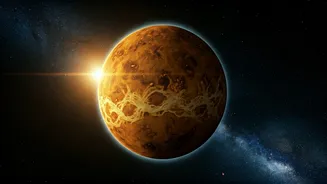
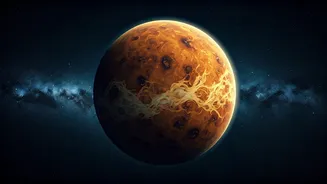
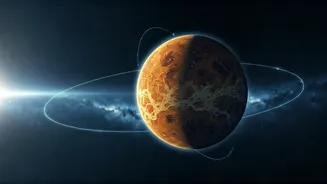
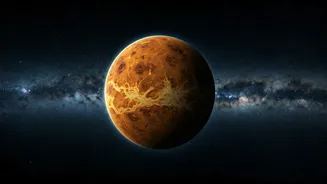
Let’s get this straight, because it’s a genuine mind-bender. Venus takes about 225 Earth days to complete one orbit around the Sun. That’s its year. However, it takes a staggering 243 Earth days to rotate just once on its axis. This means if you were
standing on Venus, one full day-night cycle would feel incredibly long, and you'd celebrate your 'new year' before you even saw the sun rise and set once. To put it in perspective, our Earth day is 24 hours, and our year is 365 days. Venus completely flips that script. This incredibly slow spin, the slowest of any planet in our solar system, is the first clue that Venus plays by its own set of rules.
Spinning the Wrong Way
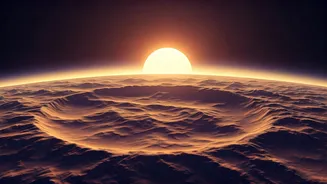
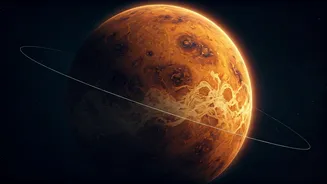
As if being the solar system's slowest spinner wasn't enough, Venus also spins backwards. All planets in our solar system, except for Venus and Uranus, rotate on their axis from west to east. This means on Earth, the Sun rises in the east and sets in the west. On Venus, it’s the complete opposite. The Sun rises in the west and sets in the east. This backward motion is known as retrograde rotation. This peculiar combination of a slow, retrograde spin makes Venus a major puzzle for planetary scientists. Why would one planet defy the standard direction of rotation that seems to govern the rest of the neighbourhood?
The Mystery of the Slowdown
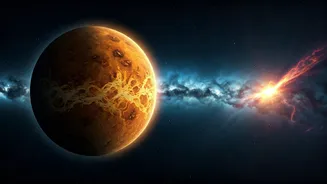
So, what caused Venus to become so sluggish and contrary? Scientists don't have a single, confirmed answer, but there are a few leading theories. One popular hypothesis is that early in its history, Venus suffered a colossal impact from a massive asteroid or protoplanet. Such a powerful collision could have been strong enough to not just halt its original spin but actually reverse it, leaving it with the slow, backward rotation we see today. Another compelling theory involves Venus's incredibly thick atmosphere. This dense blanket of gas—about 90 times thicker than Earth's—could be creating a powerful atmospheric tide. Over billions of years, the gravitational pull of the Sun on this thick atmosphere could have acted like a brake, slowing the planet's rotation to its current crawl.
Not Just Slow, But Hostile
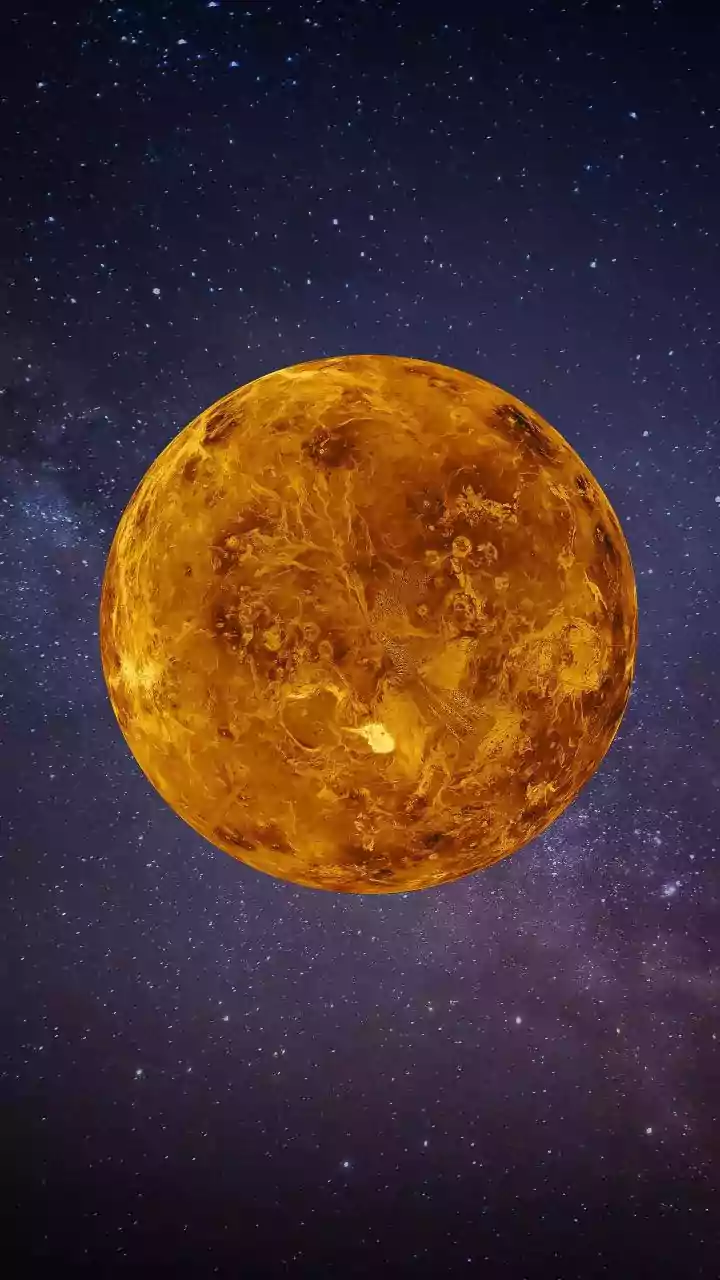
The slow rotation is just one feature of a planet that is utterly hostile to life as we know it. Often called Earth's 'evil twin' due to its similar size and mass, Venus is a world of extremes. Its thick atmosphere is composed mainly of carbon dioxide, creating a runaway greenhouse effect. This traps heat so effectively that surface temperatures average around 465°C, hot enough to melt lead. The atmospheric pressure at the surface is another crushing obstacle, equivalent to being 900 metres deep in Earth's ocean. So, while its slow, lazy day might sound relaxing, it’s taking place in what can only be described as a planetary pressure cooker. It's a stark reminder that even a planet so close to ours can evolve in a completely different, and far more inhospitable, direction.