
The Needle in a Cosmic Haystack
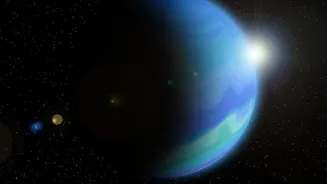
Imagine trying to see a firefly hovering next to a brilliant stadium floodlight from kilometres away. That’s the scale of the challenge astronomers face. The light from a distant star is billions of times brighter than the light filtered through or reflected
by the atmosphere of an orbiting exoplanet. Directly imaging the atmosphere is almost always impossible. Instead, scientists have to get clever by looking for the star's light to change in incredibly subtle ways.
Waiting for a Shadow: The Transit Method
The primary technique for this incredible feat is called transit spectroscopy. It relies on a specific alignment: the exoplanet must pass directly between its star and our telescopes. This event is called a transit. As the planet crosses in front of the star, it blocks a tiny fraction of the starlight, causing a minuscule and periodic dip in the star's brightness. While this dip itself confirms the planet's existence and size, the real magic happens at the very edges of the planet's silhouette, where the starlight grazes through its atmosphere.
Decoding the Barcode of Light
The key is spectroscopy, the science of splitting light into its constituent colors, like a prism creating a rainbow. When starlight passes through an exoplanet’s atmosphere, the gases present absorb very specific wavelengths, or colors, of that light. Every chemical element and compound, whether it's water vapor, methane, or carbon dioxide, has a unique spectral signature—a pattern of dark lines where light has been absorbed. This pattern acts like a chemical barcode, telling astronomers what the atmosphere is made of.
The Art of Subtraction
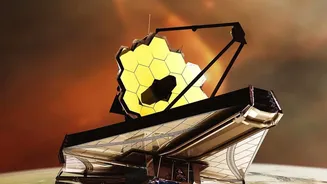
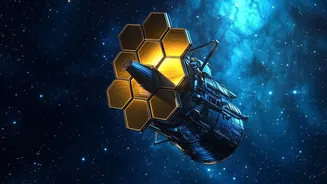
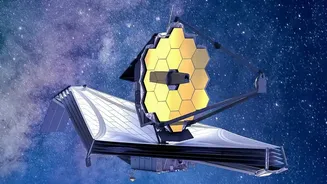
Here's how scientists isolate that faint atmospheric signal from the star's overwhelming noise. First, they use a powerful telescope like the James Webb Space Telescope (JWST) to capture a clean, baseline spectrum of the star when the planet is not transiting. This tells them exactly what the starlight looks like on its own. Then, they capture another spectrum during the transit, when the starlight is being filtered through the planet’s atmosphere. By carefully subtracting the first spectrum from the second, they can cancel out the star's light and be left with only the absorption lines—the barcode—created by the planet's atmosphere. This difference reveals the chemical makeup of that distant world’s air.
Technology Makes It Possible
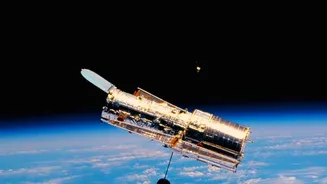
This method requires incredible precision, which is why space-based telescopes are essential. Earth’s own atmosphere absorbs light and causes turbulence, interfering with the faint signals from exoplanets. Telescopes like JWST are equipped with highly sensitive spectrographs designed to capture these minute changes in infrared light, where the signatures of many key molecules are most prominent. For example, JWST has already used this technique to provide the first clear, indisputable evidence of carbon dioxide in an exoplanet’s atmosphere, a huge milestone in the field. By isolating these faint chemical fingerprints, scientists are paving the way to one day find biosignatures—the chemical hints of life—on worlds beyond our own.