



Why One View Is Never Enough
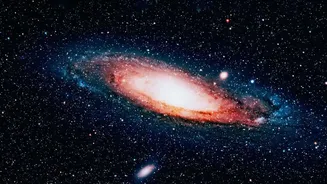
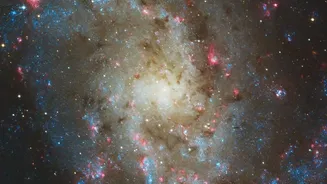
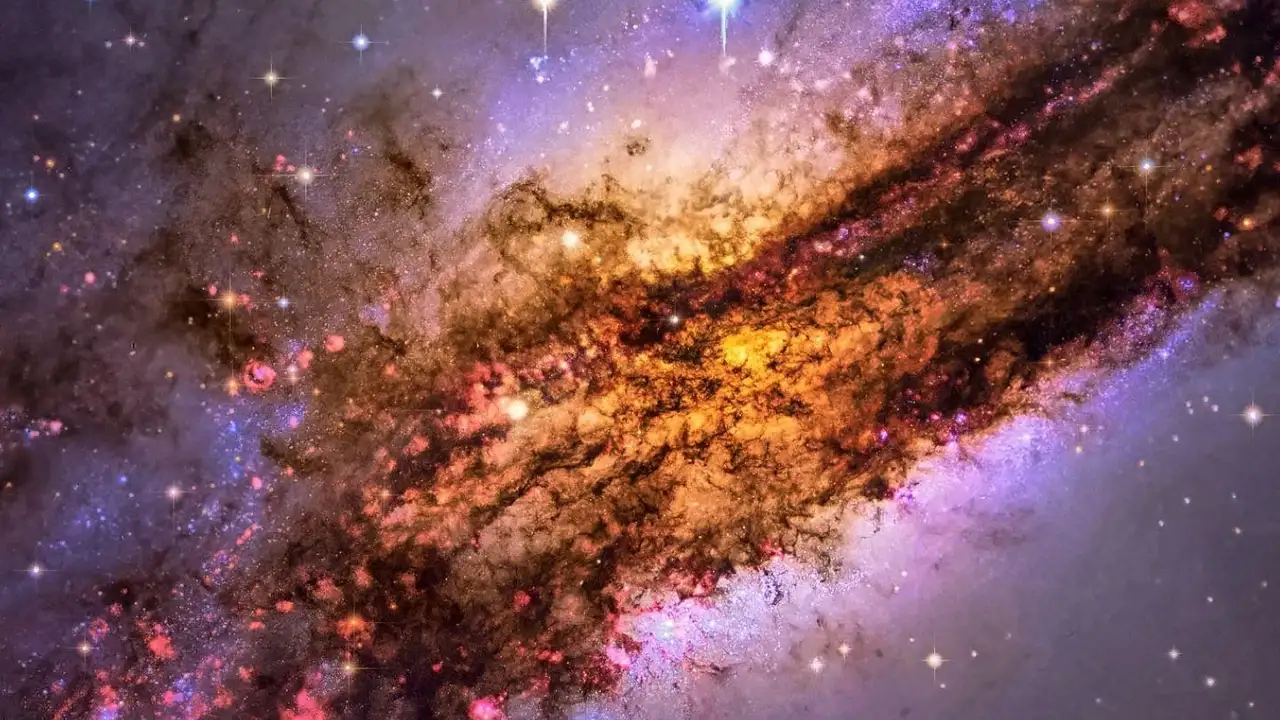
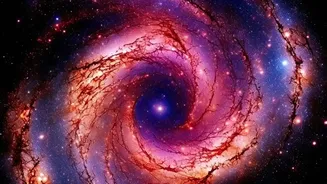
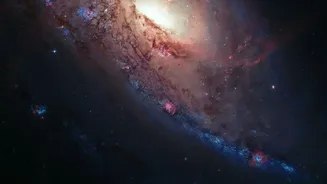
When we see a stunning image of a spiral galaxy, we are typically looking at it in visible light—the same kind of light our eyes perceive. This view is beautiful, but it primarily shows us the distribution of stars. It's an incomplete portrait. A galaxy is a complex
ecosystem of stars, gas, dust, and often, a supermassive black hole at its core. Much of this cosmic machinery is invisible to us. Vast clouds of cold gas where new stars are born, and the incredibly hot, violent regions around a black hole, do not shine brightly in visible light. Relying on one wavelength is like listening to an orchestra with only the violins playing; you hear part of the music, but you miss the richness and complexity of the full composition. To truly understand how a galaxy works, astronomers must become cosmic detectives, gathering clues across the entire spectrum of light.
The Universe's Hidden Rainbow
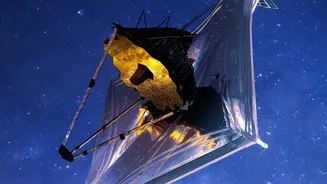
The light we see is just a tiny sliver of the electromagnetic spectrum, a vast range of radiation that includes everything from radio waves to gamma rays. Different astronomical objects and processes emit light at different wavelengths, depending on their temperature and energy. By using specialized telescopes, astronomers can observe these otherwise invisible phenomena. Infrared telescopes, like the James Webb Space Telescope, are sensitive to heat. They can peer through thick clouds of cosmic dust to reveal newborn stars nestled within and see the faint glow of cooler, older stars. On the other end of the spectrum, X-ray observatories like NASA's Chandra X-ray Observatory detect extremely high-energy events. X-rays are produced by material heated to millions of degrees, such as the gas being pulled into a black hole or the debris from an exploded star. Radio telescopes, meanwhile, can map out vast clouds of cool gas, the raw fuel for future star formation. Each wavelength provides a unique and vital piece of the puzzle.
A Cosmic Collision in Different Hues
A perfect example of this multi-wavelength approach is the study of Stephan's Quintet, a group of five galaxies, four of which are locked in a gravitational dance. In infrared light, as seen by the James Webb Space Telescope, the view is spectacular. We see sweeping tails of gas and dust being pulled from the galaxies as they interact, and we can pinpoint bright bursts of star formation triggered by the cosmic collision. But this is only part of the story. When NASA's Chandra X-ray Observatory viewed the same scene, it revealed something entirely different: a colossal shock wave, invisible in infrared, where one of the galaxies is crashing through the group at about 2 million miles per hour. This collision is heating the intergalactic gas to tens of millions of degrees, making it glow brightly in X-rays. Without the X-ray view, this immensely energetic and crucial part of the interaction would be completely missed.
Weaving the Complete Cosmic Tapestry
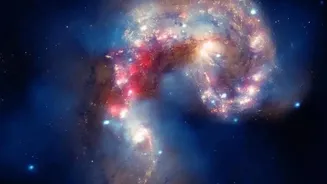
Combining these different views is where the real scientific discovery happens. Astronomers take the data from various telescopes—infrared from Webb, X-rays from Chandra, visible light from Hubble—and layer them together to create a single composite image. Often, the invisible wavelengths are assigned colors our eyes can see (like blue or purple for X-rays, and red or orange for infrared) to make the different components distinguishable. This isn't just for creating beautiful pictures; it's a powerful analytical tool. In the case of Stephan's Quintet, the combined image shows exactly how the high-speed galactic collision seen in X-rays is directly connected to the frantic bursts of new star formation seen in infrared. It allows scientists to trace cause and effect across millions of light-years, building a complete physical model of how galaxies evolve, interact, and grow. This technique provides a holistic picture that no single observation ever could.