







What Exactly is an Optical Skyrmion?
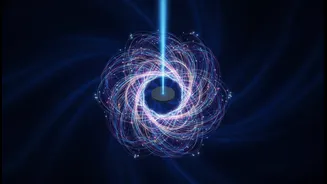
First imagined in the 1960s for particle physics, a skyrmion is a stable, particle-like knot or swirl in a field. Originally, this applied to magnetic fields, where they are like tiny magnetic whirlwinds. Think of them as incredibly robust patterns that
don't easily unravel, making them ideal for holding information. In recent years, scientists have explored creating these structures not with magnets, but with light itself—forming 'optical skyrmions'. These are intricate, self-contained patterns encoded in the properties of a light beam, such as its polarization and phase. Their structure is often compared to the spines of a hedgehog, forming a unique, resilient topology. This stability is their superpower; unlike a simple flash of light, a skyrmion holds its shape, making it a potential building block for next-generation technologies.
A Breakthrough from a 200-Year-Old Effect
The latest breakthrough, from researchers at Nanyang Technological University in Singapore, is remarkable for its simplicity. Previously, creating optical skyrmions required complex, expensive engineered materials known as metamaterials. The new method revives a 200-year-old phenomenon known as the Arago spot, or Poisson spot. In the early 19th century, scientists debated whether light was a particle or a wave. French physicist Siméon Denis Poisson, a skeptic of the wave theory, calculated that if light were a wave, shining it on a solid circular disc would paradoxically create a bright spot right in the middle of its shadow. This was intended to be a ridiculous prediction, but François Arago performed the experiment and found the spot, providing strong proof for the wave nature of light. More than two centuries later, scientists have found that this very effect—the diffraction of light around a simple disc—naturally creates the complex conditions needed to form multiple types of optical skyrmions at once.
Why This Matters for Future Technology
The ability to easily create stable, tiny patterns of light has enormous implications. The primary application is in data storage and processing. Because skyrmions are so robust, they could be used to encode data in a way that is far denser and more energy-efficient than current technologies. Information could be stored in the topological state, or 'shape,' of the skyrmion. This opens the door for 'photonic computing,' where information is processed using light instead of electrons, promising much faster and more efficient devices. Beyond computing, optical skyrmions could revolutionize other fields. Their unique properties can be used for ultra-high-resolution imaging, allowing us to see details at a scale far smaller than the wavelength of light itself—a technique known as super-resolution microscopy. They also have potential uses in quantum technologies, where their inherent stability could help protect fragile quantum states from disturbances.
What Are the Next Steps?
This discovery significantly lowers the barrier to entry for studying and experimenting with optical skyrmions. By replacing expensive metamaterials with a simple laser and a disc, more research groups around the world can now explore their potential. A key finding from the NTU team was that their method simultaneously created four different types of skyrmions: electric field, magnetic field, spin, and Stokes skyrmions. This allows researchers to study the relationships between the different properties of light within a single, simplified system. The next phase of research will focus on controlling and manipulating these light patterns. Scientists will work on tuning their size, shape, and topological properties, which is essential for encoding information. While commercial applications are not imminent, this breakthrough represents a critical step toward building the foundational knowledge needed for the next generation of light-based technologies.