
A Glimpse into a Star's Final Moments
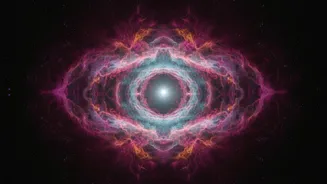
The Helix Nebula is what’s known as a planetary nebula—not because it has planets, but because its round shape resembled one to early astronomers. In reality, it’s the beautiful remnant of a star, much like our own sun, at the end of its life. After running
out of fuel, the star shed its outer layers of gas and dust into space. At the center of this expanding shell is a white dwarf, the superheated core of the once-mighty star, whose intense radiation now illuminates the gas it cast off, creating the celestial artwork we can see. Because it is one of the closest such objects to Earth, it provides a unique laboratory for studying the life cycle of stars.
The Mystery of the 'Cometary' Knots
Dotted along the inner ring of the nebula are thousands of peculiar structures that astronomers have dubbed "cometary knots". These aren't actual comets, but they have glowing heads and long, streaming tails that give them a similar appearance. The sheer scale is hard to comprehend: each knot's head is roughly twice the size of our solar system, with tails stretching for 100 billion miles. While they appear tiny from our vantage point, these knots are colossal. Scientists have long been fascinated by them, with estimates suggesting there could be as many as 40,000 within the nebula. Their existence wasn't predicted, and understanding their origin has been a persistent puzzle.
Webb's Infrared Eye Provides New Clues
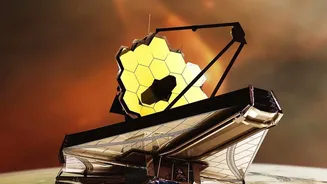
Previous observations from telescopes like Hubble gave us stunning views, but the James Webb Space Telescope's power to see in infrared light has provided an unprecedented new level of detail. A recent image from Webb's Near-Infrared Camera (NIRCam) pierces through the nebula's ethereal gas and dust, bringing the structure of these knots into sharp focus. The new view highlights how fierce stellar winds from the central white dwarf are crashing into cooler gas and dust that were ejected by the star thousands of years earlier. This collision fragments the smooth clouds of gas, sculpting them into the tadpole-like shapes we observe. Webb's clarity shows the stark transition from hot, ionized gas near the star to cooler molecular gas farther out.
It's All About Density and Motion
The leading hypothesis, now bolstered by Webb's observations, is that the knots are denser, cooler clumps of gas and dust, possibly formed during the star's earlier ejections. The powerful, faster-moving wind from the central star blows past these denser globules. The side of the knot facing the star is illuminated and ionized, creating the bright "head." The rest of the globule is shielded, forming a long, dark tail of molecular gas streaming away—much like a giant rock in a river creates a wake behind it. So, these are not objects plowing through space, but rather stationary clumps being eroded by powerful stellar winds, with each knot containing about the same mass as Earth.
A Preview of Our Solar System's Fate
Studying the Helix Nebula isn't just an academic exercise; it's a preview of our own sun's distant future. In about five billion years, our sun will exhaust its fuel and swell into a red giant, eventually shedding its outer layers to form its own planetary nebula. The detailed processes Webb is revealing in the Helix Nebula—how stellar material is recycled back into the cosmos to form new stars and potentially new planets—is a direct look at the final chapter of our own solar system. These cosmic knots, once a deep mystery, are now helping us understand the ultimate fate of stars and the building blocks of the next generation of worlds.