



A New Cosmic Surveyor
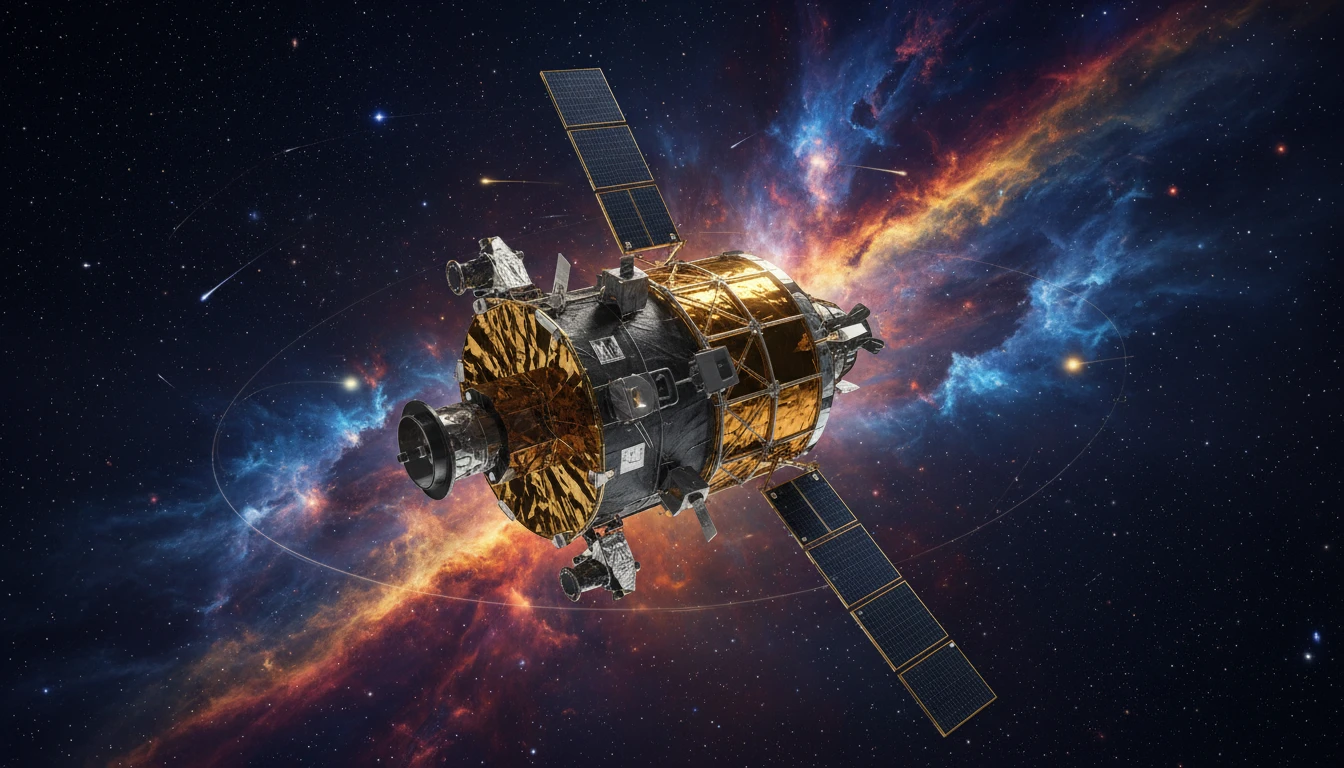
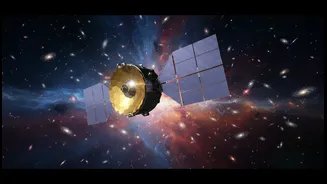
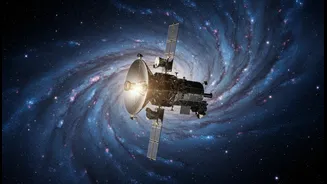
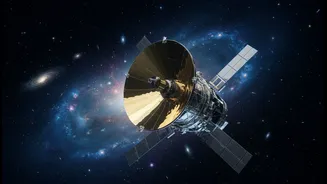
Set to launch on a SpaceX Falcon Heavy rocket on August 30, 2026, the Nancy Grace Roman Space Telescope is NASA's next great observatory. Named after Nancy Grace Roman, NASA's first Chief of Astronomy, this telescope isn't designed to simply replace its
famous predecessors. Instead, it has a unique and powerful mission: to survey the sky with unprecedented speed and scale. Its primary mirror is the same size as Hubble's, but its innovative design gives it a field of view 100 times larger. This means that while Hubble and Webb are like microscopes, zooming in on specific cosmic targets with incredible detail, Roman is like a panoramic camera, built to create vast, sweeping maps of the universe.
The Power of a Panoramic View
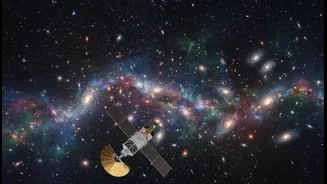
The key to Roman's power is its Wide Field Instrument (WFI), a mammoth 300-megapixel camera. This instrument will allow the telescope to capture images with the same stunning resolution as Hubble but across a patch of sky larger than the full Moon. In its five-year primary mission, Roman is expected to image over 50 times the area of sky that Hubble has covered in more than 30 years. This incredible survey speed will generate an enormous amount of data—an estimated 20 petabytes over its mission—which will help astronomers tackle some of the biggest questions in cosmology by studying galaxies and stars on a statistical level never before possible.
Hunting for Dark Energy
One of Roman’s primary goals is to unravel the mystery of dark energy, the enigmatic force causing the universe's expansion to accelerate. No one knows what it is, but it's believed to make up about 68% of the universe. Roman will tackle this problem in several ways. It will map the three-dimensional positions of billions of galaxies and clusters, observing how their distribution has changed over cosmic history. It will also hunt for thousands of Type Ia supernovae, a specific kind of stellar explosion that serves as a 'standard candle' for measuring cosmic distances. By precisely measuring how the universe's expansion has changed over time, scientists hope to finally understand the nature of dark energy.
A Census of New Worlds
Beyond cosmology, Roman is set to revolutionize the search for exoplanets. While the Kepler and TESS missions found thousands of planets using the 'transit' method—watching for the slight dimming of a star as a planet passes in front of it—Roman will primarily use a different technique called gravitational microlensing. This method detects planets by observing how their gravity, and that of their host star, bends and magnifies the light from a more distant background star. This technique is particularly sensitive to planets that are further from their stars, in orbits similar to those in our own solar system, as well as free-floating 'rogue' planets that don't orbit a star at all. Projections suggest Roman could discover around 100,000 new exoplanets, potentially finding analogs to nearly every planet in our solar system.
A New Era of Discovery
After its launch in August 2026, Roman will journey to the second Sun-Earth Lagrange point (L2), a stable gravitational point about 1.5 million kilometers from Earth, where the James Webb Space Telescope also resides. Once operational, it won’t work in isolation. Roman is designed to be a discovery machine, identifying tens of thousands of interesting targets—from distant supernovae to nearby exoplanets—that more focused observatories like Webb can then study in greater detail. This synergy between the wide-angle surveyor and the high-detail observers will define the next era of astronomy. The telescope has already arrived at the Kennedy Space Center in Florida for its final pre-launch preparations, marking a major milestone for a mission that is currently ahead of schedule.