







The Science of Strength in Lowering
A negative pull-up isolates the lowering (or eccentric) portion of the movement. You start with your chin over the bar and slowly lower your body down. The magic lies in the physiology of eccentric contractions: your muscles can handle significantly more
load while they are lengthening than when they are shortening (the concentric or 'pulling up' phase). Studies show you are roughly 30-50% stronger during the eccentric phase. This means that even if you can't perform a single pull-up, you can still overload your muscles with your full body weight during a controlled descent. This creates greater mechanical tension and micro-tears in the muscle fibres, which is a primary signal for your body to adapt by building more strength and muscle mass. It is this targeted overload that makes negatives one of the most effective tools for building the raw strength needed to achieve a full pull-up.
How to Perform the Perfect Negative
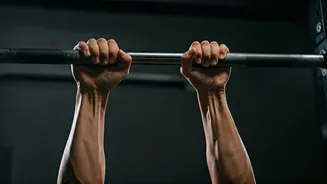
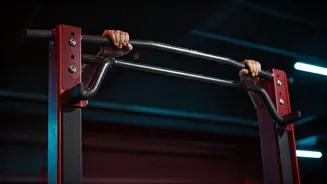
Proper form is crucial to maximise results and prevent injury. Begin by placing a sturdy box or bench under a pull-up bar, high enough that you can easily get your chin above the bar. Grab the bar with an overhand grip, slightly wider than your shoulders. Jump or step up so your chin is above the bar. Before you begin to lower, engage your entire body: squeeze your glutes, brace your core, and pull your shoulder blades down and back. This creates stability and ensures your back muscles do the work. The descent is the most important part. Lower your body as slowly and smoothly as possible, aiming for a count of three to five seconds initially. Do not simply drop. Control every inch of the movement until your arms are fully extended in a dead hang at the bottom. Then, step back onto the box and repeat. Quality trumps quantity; one perfectly controlled five-second negative is far more valuable than five fast, jerky ones.
Muscles Worked and Key Benefits
The negative pull-up is a compound exercise that targets nearly the entire upper body. The primary movers are the latissimus dorsi (lats), the large muscles of your back that create a 'V' shape. It also heavily recruits the biceps, rhomboids, trapezius, and rear deltoids. Furthermore, your forearms and grip strength will improve dramatically from controlling your bodyweight for an extended period. A tight core is essential to prevent swinging, so your abdominal muscles and erector spinae also get a great workout. Beyond building foundational strength, controlled negatives improve your neuromuscular control—the communication between your brain and muscles—teaching your body the precise movement pattern of a pull-up under tension. This builds not only stronger muscles but also more resilient tendons, helping to bulletproof your shoulders and elbows against injury.
Common Mistakes to Avoid
The most common mistake is lowering too quickly. Dropping from the bar negates the eccentric overload, robbing you of the exercise's main benefit. If you can't control the descent for at least three seconds, you may need to build foundational strength with dead hangs and assisted pull-ups first. Another frequent error is losing tension and allowing the body to swing. This indicates a disengaged core. Keep your body in a slight 'hollow' position by bracing your abs and glutes. Avoid flaring your elbows out wide or letting your shoulders shrug up toward your ears; instead, think of pulling your elbows down toward your hips to keep your lats engaged. Finally, don't just focus on getting your chin over the bar by craning your neck. Maintain a neutral chin position throughout the movement.
Programming for Progress
To see real results, consistency is key. Incorporate negative pull-ups into your routine two to three times per week, allowing at least one day of rest in between for recovery. A good starting point for beginners is 3 sets of 3-5 reps, focusing on that slow 3-5 second descent. The primary goal is to increase the time under tension. Once you can comfortably perform 5 reps with a 5-second descent, work on extending that time to 8, or even 10 seconds. After several weeks of consistent training, you can test your progress by attempting a full pull-up. You can also pair negatives with other back-strengthening exercises like inverted rows, scapular pulls, and dead hangs to build a well-rounded and powerful upper body.