







What is Dual-Use AI Knowledge?
Dual-use technology is any innovation that can be applied for both peaceful and military, or beneficial and harmful, purposes. The concept isn't new—it's been applied to everything from nuclear physics to gene editing. However, with artificial intelligence,
the stakes are different. The same AI system that can accelerate drug discovery or find critical cybersecurity vulnerabilities can also be used to engineer bioweapons or develop new cyberattacks. Unlike a physical object, AI knowledge is information, making it incredibly difficult to contain. Advanced AI models are trained on vast datasets, and within them, they develop a deep understanding of many subjects, some of which are inherently risky, such as virology, chemistry, and cyber warfare. The concern is that as these models become more powerful and accessible, they could lower the barrier for malicious actors to cause widespread harm.
The 'Off Switch' Metaphor
So, what does an 'off switch' for AI knowledge actually look like? It's less a single red button and more a sophisticated set of containment strategies. The simplest version is a 'kill switch' that can pause or completely shut down a misbehaving AI system by revoking its access to tools and data. But a truly effective solution has to be more surgical. The goal is to disable a model's dangerous capabilities without harming its useful ones. Some researchers are exploring techniques to isolate risky information during the AI's training process. One recent approach, developed in a collaboration involving Anthropic, involves creating dedicated, removable compartments within the model for specific types of dual-use knowledge. For example, all information related to virology would be stored in a 'virology module.' This module could then be deleted or deactivated for most users, but made available to trusted researchers in a secure environment. This prevents the dangerous knowledge from diffusing throughout the entire model, making it easier to control.
The Innovation Dilemma
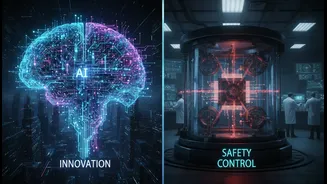
The push for control mechanisms raises a difficult question: how do we prevent misuse without stifling innovation and open research? Many of the most significant breakthroughs in science have come from the free exchange of ideas. Imposing rigid controls on AI development could slow down progress in beneficial areas, from medicine to climate science. Critics of heavy-handed regulation argue that treating AI as inherently dual-use is problematic because almost any technology can be misused. They advocate for a more flexible approach, focusing on tangible harms rather than speculative risks. There is also a major debate around open-source AI. While making powerful models publicly available can democratize access and accelerate innovation, it also means giving away the keys to potentially dangerous systems with no effective way to monitor their use. Finding the right balance between openness and security is one of the most significant challenges facing the industry.
Who is Building the Locks?
The responsibility for managing dual-use risks is falling on a combination of AI companies, academic researchers, and governments. Leading AI labs like Anthropic, Google DeepMind, and OpenAI are actively researching safety measures and, in some cases, calling for government regulation. Anthropic, for instance, has proposed a framework that would give governments the authority to block the deployment of models that pose a catastrophic risk, with penalties tied to revenue. This would apply only to the most powerful 'frontier' models. Meanwhile, governments are beginning to act. The United States, European Union, and China have all introduced or are developing regulations around AI. International summits have led to voluntary agreements among nations and AI developers to cooperate on safety. However, there is currently no global consensus on how to classify and regulate dual-use AI, leading to a patchwork of policies that may struggle to keep pace with the technology's rapid advancement.