


Our Planet’s Electronic Weakness
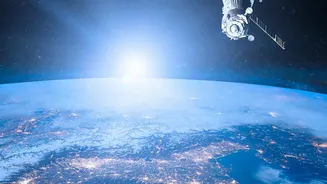
We live in an electrically-powered and digitally-connected society. From the national power grid that lights our homes to the GPS signals that guide our planes and cars, our daily lives depend on a delicate infrastructure. This very infrastructure is vulnerable
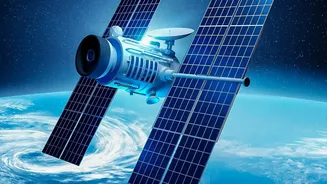
to what scientists call 'space weather'. Caused by activity on the Sun, a severe space weather event can induce damaging electrical currents in power lines, disrupt radio communications, and knock out the satellites we rely on for everything from weather forecasting to financial transactions. The threat isn't hypothetical; a powerful solar storm in 1859, known as the Carrington Event, set telegraph offices on fire. A similar event today could have a far more devastating impact on our deeply interconnected world.
The Sun’s Violent Tantrums
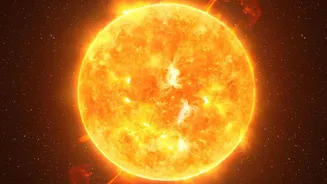
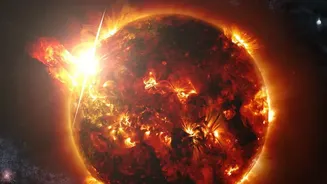
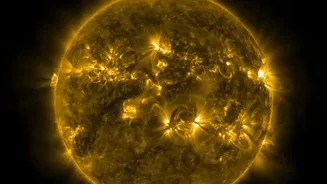
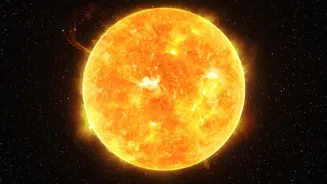
The primary drivers of space weather are solar flares and Coronal Mass Ejections (CMEs). A solar flare is an enormous explosion on the Sun's surface, an intense burst of radiation that reaches Earth in just eight minutes. Flares are often, but not always, accompanied by CMEs, which are the real heavyweights. A CME is a colossal eruption of magnetised plasma—billions of tonnes of solar material—blasted into space at speeds up to millions of kilometres per hour. While solar flares can cause immediate radio blackouts on the sunlit side of Earth, it's the slower-moving CMEs that pose the biggest threat to our power grid and satellites. These massive particle clouds take one to five days to travel to Earth, giving us a crucial, albeit short, window to prepare.
An Artificial Eclipse in Space
To see an incoming CME, scientists need to stare directly at the Sun, but there's a problem: the Sun is blindingly bright, and its faint outer atmosphere, the corona, is where CMEs are born and become visible. To see the faint corona, you must block the Sun's direct light. This is the job of a coronagraph, a special telescope invented in the 1930s to create an artificial eclipse. A simple way to understand this is to hold your thumb up to block out the bright sun; you can suddenly see things in the sky around it. A satellite-based coronagraph does the same thing with far more precision, using an 'occulting disk' to block the Sun's main body. This allows it to capture images of the much fainter corona and, most importantly, to see a CME as it erupts and billows out into space.
Our Sentinels on the Sun
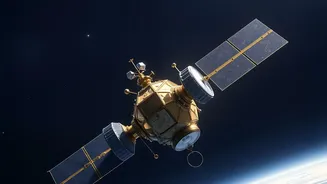
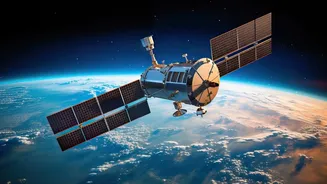
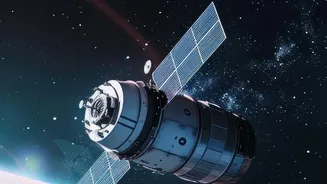
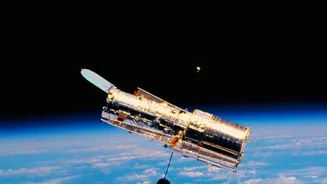
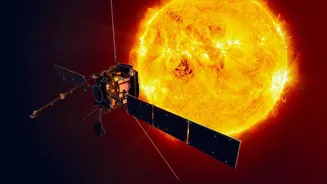
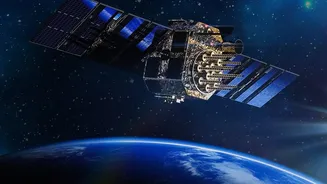
Our primary eyes on the Sun are instruments aboard satellites positioned strategically in space. The most famous of these is the Large Angle and Spectrometric Coronagraph (LASCO) instrument on the joint NASA/ESA Solar and Heliospheric Observatory (SOHO) satellite. Positioned about 1.5 million kilometres from Earth, SOHO has an uninterrupted view. LASCO uses multiple coronagraphs to view different layers of the corona, tracking a CME as it expands away from the Sun. More recently, new instruments like the Compact Coronagraphs (CCOR) on NOAA's GOES-19 and SOLAR-1 satellites have come online, enhancing our observation capabilities and providing crucial redundancy. Together, these instruments provide a continuous stream of images, allowing forecasters to spot an Earth-directed CME almost as soon as it happens.
From Data to Real-Time Warning
When a coronagraph detects a CME, the clock starts ticking. Forecasters at agencies like NOAA's Space Weather Prediction Center (SWPC) immediately analyse the images to determine the CME's size, speed, and direction. If it appears to be heading towards Earth, they use this data to run predictive models, forecasting its arrival time and potential intensity. This information is then issued as a warning, giving power grid operators time to protect their transformers, satellite operators a chance to put their spacecraft into a safe mode, and airlines the opportunity to reroute flights away from polar regions where radiation effects are strongest. This advanced warning, often between 15 and 60 minutes for the final impact shockwave, is our primary line of defence, turning scientific data into actionable steps to safeguard our technology.