



A Lonely Voyager's New Mission
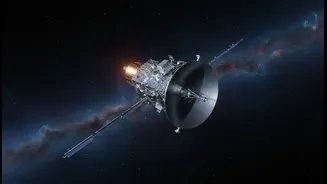
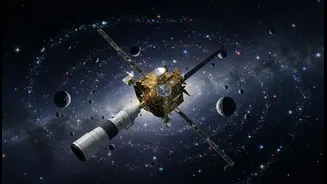
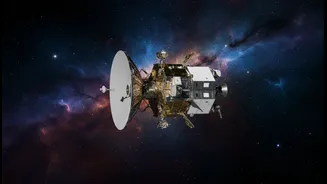
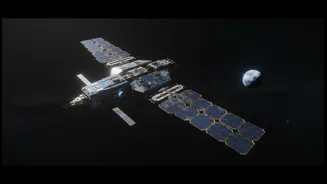
After dazzling the world with the first-ever close-up images of Pluto in 2015 and the distant object Arrokoth in 2019, the New Horizons probe might have been considered a completed success. But its journey was far from over. Mission planners have since
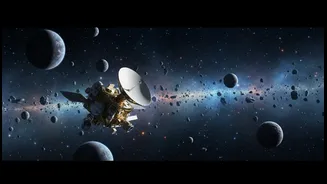
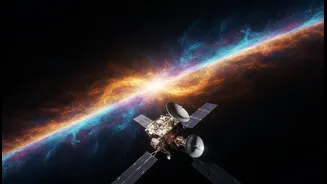
transitioned the spacecraft into a new role, exploring the outer heliosphere—the vast bubble of plasma blown by our sun. To conserve its nuclear power source for the long journey, the probe spends long stretches in hibernation. Recently, after a 321-day slumber, the spacecraft was woken up on commands sent months earlier. Now, billions of kilometres from home, its new mission is to act as humanity's most distant observatory, using its sensitive instruments to study a region no other active probe is currently exploring.
What is the Cosmic Hydrogen Wall?
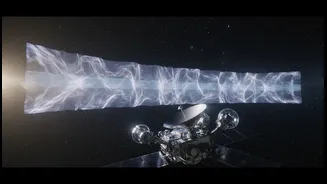
Imagine the solar system as a boat moving through water. The 'boat' is our sun, and the 'wake' it creates is the heliosphere, a bubble formed by the solar wind—a constant stream of charged particles flowing from the sun. This bubble pushes back against the interstellar medium, the mix of gas and dust that fills the space between stars. Scientists have long theorized that at the very edge of this bubble, where the solar wind slows down, there should be a region where interstellar hydrogen atoms pile up. This pile-up, predicted to be about 100 times farther from the sun than Earth, is what scientists call the "hydrogen wall." It's not a solid barrier, but a vast, invisible region of denser-than-usual hydrogen gas, marking the true boundary between our solar neighbourhood and the rest of the galaxy.
The 'Alice' in Wonderland Sensor
To find this invisible wall, New Horizons relies on a specialized instrument named Alice, a lightweight ultraviolet (UV) imaging spectrometer. Alice isn't looking for the hydrogen wall directly, but for the light it scatters. Hydrogen atoms, when energized, emit a specific wavelength of UV light known as the Lyman-alpha line. The sun bathes our solar system in this light, which is scattered by hydrogen atoms throughout space. Alice's job is to measure this faint background glow. The theory is that as New Horizons looks out towards the edge of the heliosphere, it should see a baseline level of this UV light. If a hydrogen wall exists, it would create an additional source of scattered light, making the background glow brighter.
Confirming a Decades-Old Mystery
The idea of a hydrogen wall isn't new. NASA's Voyager spacecraft, launched in the 1970s, detected a similar excess UV glow at the edge of the solar system about 30 years ago. However, with only one data point, it was difficult to be certain. New Horizons, with its more modern and sensitive Alice instrument, provides the first opportunity to corroborate those historic findings. In 2018, the mission team announced that Alice had indeed detected an excess UV glow consistent with the Voyager data, providing strong evidence that the hydrogen wall is real. The spacecraft continues to take measurements twice a year, building a map of this distant structure. Each observation campaign after awakening from hibernation adds another crucial piece to the puzzle.
Why This Cosmic Boundary Matters
Confirming the existence and mapping the structure of the hydrogen wall is about more than just checking a theoretical box. This boundary is our solar system's first line of defence against the rest of the galaxy. The heliosphere shields us from a significant amount of high-energy cosmic rays. Understanding the shape and dynamics of this boundary—how the solar wind interacts with the interstellar medium—helps scientists refine their models of how stars and their environments work across the cosmos. It tells us about the nature of the interstellar space our sun is currently traveling through and helps answer fundamental questions about our own place in the Milky Way galaxy.