



The Invisible Dance Partner
The fundamental principle behind detecting a hidden black hole is surprisingly simple. Imagine watching a dancer on a stage who appears to be waltzing with an invisible partner. They spin, dip, and sway as if held by a powerful grip, but no one is there.
You would rightly conclude they are not alone but are instead orbiting a common center of mass with an unseen companion. In space, stars do the same thing. Astronomers observe a star moving in a way that defies the known laws of gravity for a solitary object. It wobbles, or follows an elliptical path around seemingly empty space. This peculiar motion is the tell-tale sign that the star is gravitationally bound to a massive, unseen object — a potential black hole.
Reading the Wobbles
For years, the main technique for spotting this dance was the radial velocity method. By analysing the light from a star, astronomers can detect a Doppler shift. As the star moves towards us in its orbit, its light shifts to the blue end of the spectrum; as it moves away, it shifts to the red. This rhythmic back-and-forth indicates an orbit. However, this method has limitations. The last decade has seen the rise of a far more precise technique: astrometry. This is the science of meticulously measuring the positions and movements of stars. The European Space Agency's Gaia spacecraft, launched in 2013, has been the undisputed champion of this field. Gaia can measure a star's position with such incredible accuracy that it can detect the minuscule side-to-side wobble caused by an orbiting black hole, even from thousands of light-years away.
The Gaia Revolution
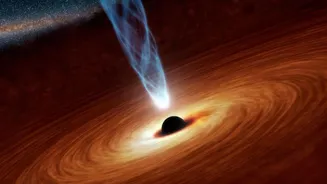
The Gaia mission has completely transformed the hunt for black holes. Before Gaia, most known stellar-mass black holes were 'active', meaning they were close enough to a companion star to pull material from it. This process creates a hot, X-ray-emitting accretion disk, which is relatively easy to detect. Gaia's precision allows it to find a much larger, previously hidden population of 'dormant' black holes. These black holes are not actively feeding and therefore emit no light, making them invisible to traditional methods. By tracking the subtle wobble of a star, Gaia can reveal the presence of a silent partner. Using Kepler's laws of motion, scientists can then calculate the mass of this invisible companion. If the mass is more than three times that of our sun, it's too massive to be a neutron star and is almost certainly a black hole.
A New Galactic Census
The discoveries fueled by Gaia data have been staggering. In recent years, the mission has helped identify several dormant black holes, including Gaia BH1 and Gaia BH2. More recently, it uncovered Gaia BH3, a behemoth with a mass 33 times that of the Sun, located just 2,000 light-years away. Before these findings, black holes of this size were only known to exist in distant galaxies through gravitational wave detections. Finding them in our own cosmic backyard challenges existing theories about how massive stars evolve and die. These discoveries suggest that the number of stellar-mass black holes in the Milky Way could be in the thousands or even millions, far more than the handful of active ones previously known.