








From Myth to a Scientific Mission
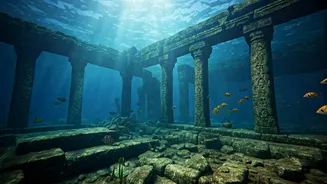
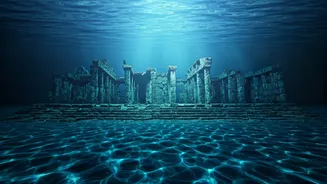
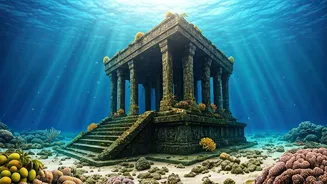
The story of Mahabalipuram's submerged temples has been passed down through generations, with local fishermen claiming to see glimpses of structures beneath the waves. European sailors and travelers since the 18th century also documented these tales,
nicknaming the site the 'Seven Pagodas'. This enduring folklore inspired modern-day explorers and scientists. The quest wasn't just about validating a legend; it was about uncovering a potential lost chapter of Pallava dynasty history from the 7th and 8th centuries. The key players in this mission have been India's National Institute of Oceanography (NIO) and the Archaeological Survey of India (ASI), who have led systematic explorations since the early 2000s.
The High-Tech Search Beneath the Waves
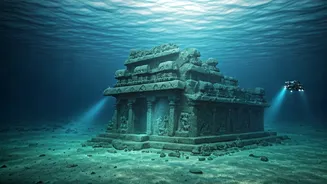
Finding man-made structures on the vast seabed is like looking for a needle in a haystack. The first step is to map the ocean floor without disturbing it. Archaeologists employ sophisticated tools, primarily side-scan sonar. This technology is towed behind a boat and sends out acoustic pulses, creating a detailed image of the seafloor's topography. It can reveal anomalies and geometric shapes that don't fit natural formations—like the straight lines of a wall or the right angles of a building foundation. In recent years, the ASI's Underwater Archaeology Wing has also deployed Remotely Operated Vehicles (ROVs). These unmanned submersibles, equipped with high-resolution cameras, can get a closer look at potential sites in deep or challenging waters, enhancing both the safety and precision of the search.
Divers Get Their Hands Dirty
Once sonar and ROVs identify promising locations, it's time for human divers to investigate. This is where marine archaeology becomes a hands-on, painstaking process. Teams of trained divers, often from the NIO and the Indian Navy, descend to these sites, which lie at depths of 5 to 8 meters. Their job is to verify the sonar findings, carefully clearing away sediment and thick marine growth that often covers the structures. They document what they find through photography and meticulous drawings. Explorations off the coast of Mahabalipuram have been challenging due to strong underwater currents and swells, which have damaged and scattered the remains over centuries.
What Lies Beneath: The Discoveries
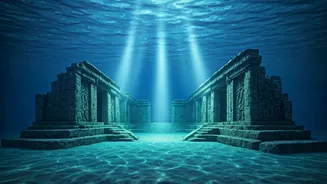
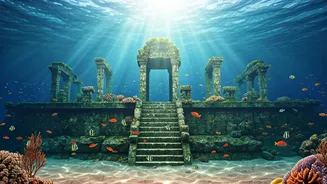
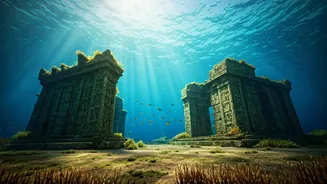
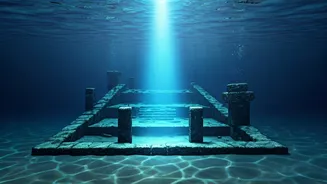
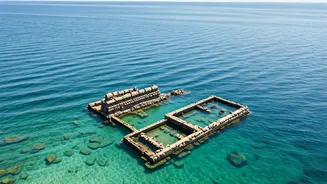
The efforts have paid off. Joint expeditions involving the NIO and ASI have confirmed the presence of man-made structures submerged off the coast. Discoveries include remains of walls, some as long as 10 meters, scattered dressed stone blocks, and what appear to be the foundations of a large building complex. Some sites revealed stone blocks with joinery projections and steps leading to a platform, all characteristic of temple construction from the Pallava era. The 2004 tsunami provided a dramatic, if destructive, clue. As the sea receded about 500 meters, locals and tourists witnessed a long row of large rocks emerge from the water, which were later identified by the ASI as part of a 6-foot-high wall. The event also uncovered new statues and temple foundations on the beach, adding more pieces to the puzzle.
Piecing Together an Ancient Puzzle
Finding ruins is only half the battle. Archaeologists must then date and contextualise them. Based on the style of construction and comparison with on-shore Pallava monuments like the Shore Temple, the submerged structures are estimated to be around 1,500 years old. Radiocarbon dating of calcareous material that has grown on the stone blocks since their submergence helps pinpoint when they went underwater. Studies by the NIO suggest the submergence may have happened in phases, possibly due to severe coastal erosion, seismic activity, or past tsunamis that dramatically altered the shoreline. Each discovery helps confirm that the ancient port city of Mahabalipuram was likely larger than what is visible today, with significant parts of it now lying beneath the Bay of Bengal.