

An Enduring Cosmic Marvel
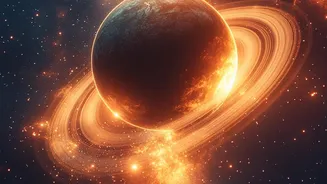
First observed by Galileo Galilei in 1610, who mistook them for 'ears' or moons, Saturn's rings have been a source of fascination and study ever since. We now know they aren't solid but are composed of countless individual particles of water ice with
traces of rock and dust, ranging in size from tiny grains to chunks as large as mountains. This system of rings is the most extensive and complex in our solar system, with a vast diameter but an astonishingly thin profile, typically only about 10 meters thick. This composition of highly reflective ice is why they shine so brightly, unlike the fainter ring systems of Jupiter, Uranus, and Neptune.
The Great Age Debate
One of the biggest puzzles is the age of the rings. For a long time, scientists were split into two camps: those who believed the rings were ancient, forming alongside Saturn 4.5 billion years ago, and those who argued they were a much more recent phenomenon. Data from NASA's Cassini spacecraft, which studied Saturn for 13 years, has largely favoured the 'young rings' theory. Analysis of cosmic dust collected by Cassini suggests the rings have only been gathering this dust for 100 to 400 million years, making them potentially younger than some dinosaurs. This evidence is based on how pristine and bright the ice is; older rings would be darker and dirtier from continuous pollution by micrometeoroids. However, the debate is not fully settled, with some recent computer models suggesting the rings could be as old as the planet itself.
A Violent, Mysterious Origin
If the rings are indeed young, how did they form? The leading theories involve catastrophic violence. One popular hypothesis suggests the rings are the remains of a large, icy moon that strayed too close to Saturn and was ripped apart by the planet's immense gravity. In this scenario, a lost moon—hypothetically named 'Chrysalis'—was gravitationally disturbed, possibly by Saturn's largest moon Titan, and sent on a collision course with its parent planet. While most of the moon would have been swallowed by Saturn, the icy remnants would have settled into the orbit we see today. Another variation suggests a moon was shattered by a collision with a large comet or asteroid, or that two icy moons collided with each other. Simulations show that the collision of two moons could explain the high concentration of ice and scarcity of rock in the rings.
A Fading Masterpiece
The Cassini mission also made a startling discovery: the rings are disappearing. The spacecraft found that particles from the rings are being pulled inward by Saturn's gravity and magnetic field, falling onto the planet as a dusty 'ring rain'. This process is draining the rings of tons of material every second. Scientists estimate that, at the current rate, the rings could be gone in as little as 100 million years, while other estimates suggest they could last a few hundred million more. This ephemeral nature adds a sense of urgency to the scientific quest. We may be living in a very special, fleeting moment in our solar system's history when Saturn is so spectacularly adorned.