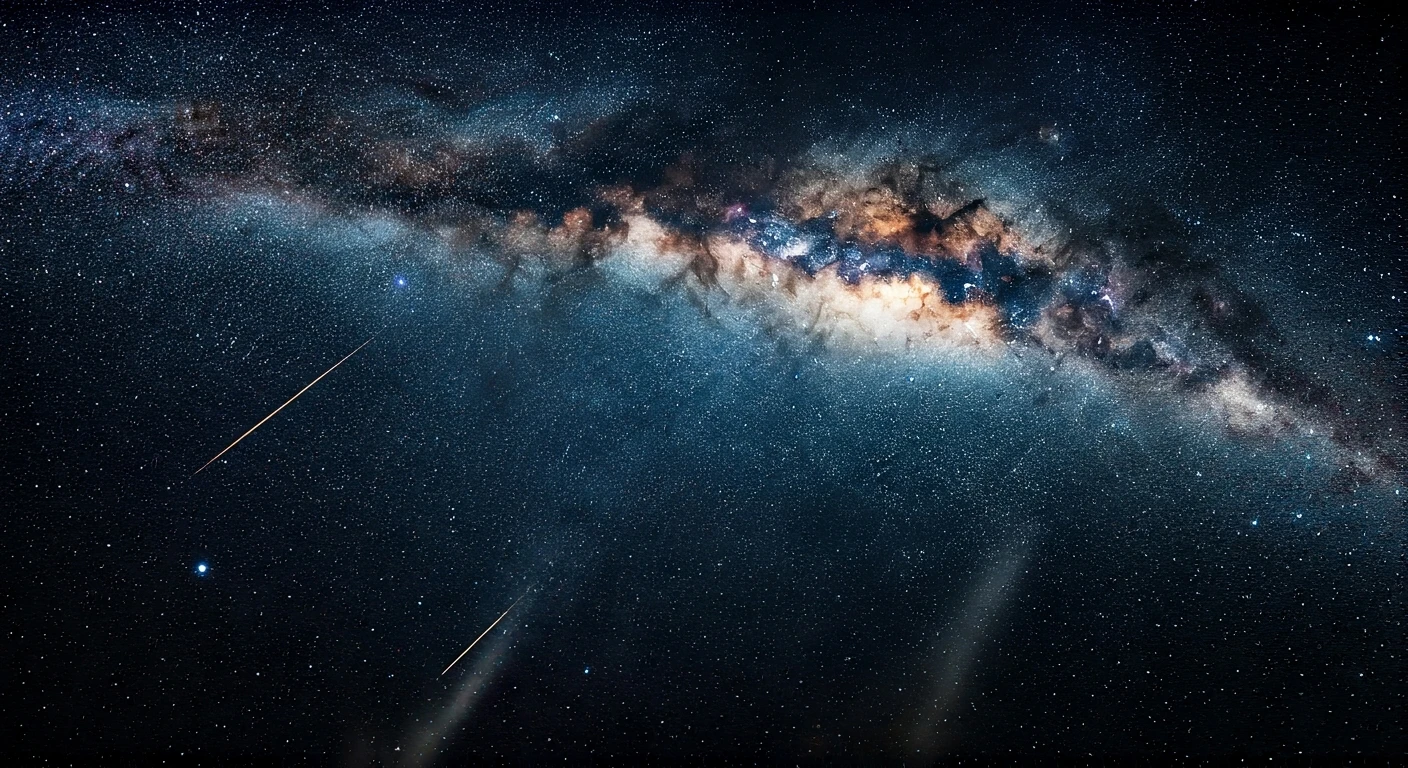




The Ultimate Time Machine is Light
The phrase 'intergalactic time travel' sounds like science fiction, but it’s a reality you experience every time you look up. The universe’s ultimate time machine isn’t a gleaming metal pod, but the very light that travels through space. Light, though
incredibly fast, has a finite speed. It travels at approximately 300,000 kilometres per second. While that seems instantaneous on Earth, the cosmos is so vast that it takes light years, centuries, and even millennia to cross the void. A light-year isn’t a measure of time, but the staggering distance light travels in one year: about 9.5 trillion kilometres. So, when we see a star that is 100 light-years away, we are seeing it as it was 100 years ago. The light just finished its long journey to your eyes.
Postcards from Our Cosmic Neighbourhood
This effect begins closer than you think. The light from our own Sun takes about 8 minutes and 20 seconds to reach Earth. If the Sun were to suddenly vanish, we would remain in blissful ignorance for over eight minutes. The same principle applies to the stars. The nearest star system to us, Alpha Centauri, is about 4.3 light-years away. The light we see from it tonight left when you were perhaps in a different school grade or starting a new job. That stellar twinkle is a snapshot of the star from the past. It’s a postcard with a four-year delivery time, carrying a picture of how our closest stellar neighbour looked when Virat Kohli was leading India at the T20 World Cup.
Echoes from India's Imperial Past
Let’s look further. Polaris, the North Star, has been a guide for travellers for generations. It sits about 430 light-years from Earth. This means the light hitting your retina tonight began its journey around the 1590s. At that time in India, the Mughal Empire was flourishing under Emperor Akbar. The foundations of the Golden Temple in Amritsar had just been laid. While artists were perfecting miniature paintings in royal courts, the light from Polaris was just beginning its 430-year trek across the galaxy. The star you see is a silent witness to a bygone era of Indian history. You aren't just seeing a star; you are opening a time capsule from the height of the Mughal dynasty.
The Star That Might Already Be Gone
For an even more mind-bending example, consider Betelgeuse, the bright red star in the Orion constellation. It is a red supergiant, nearing the end of its life, and is approximately 640 light-years away. Astronomers know it will eventually explode in a brilliant supernova. The twist? It might have already happened. The light we see from Betelgeuse left around the year 1380. At that time, the Tughlaq dynasty was ruling the Delhi Sultanate. It’s entirely possible that Betelgeuse exploded in a spectacular cosmic event in the 15th, 18th, or 20th century. We simply wouldn’t know yet. We are stuck watching a 640-year-old recording, waiting to see if the final episode has already aired.
A Message from Before Humanity
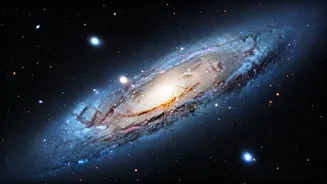
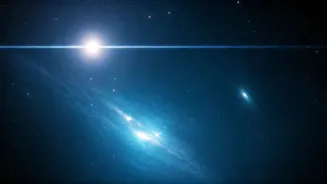
The headline mentions 'intergalactic' travel, and this is where the scale becomes truly epic. On a clear, dark night, you can spot a faint, fuzzy patch of light in the sky. That is the Andromeda Galaxy, our closest major galactic neighbour. This isn't a star, but a collection of a trillion stars. And it is 2.5 million light-years away. The light you are seeing from Andromeda is a beacon that left long before modern humans, or even Neanderthals, walked the Earth. It began its journey when our distant ancestors, early hominins like *Homo habilis*, were just beginning to use stone tools in Africa. When you look at Andromeda, you are peering across millions of years of cosmic and evolutionary history. It is the oldest story your eyes can ever see.