
It's an Immense and Persistent Jet Stream
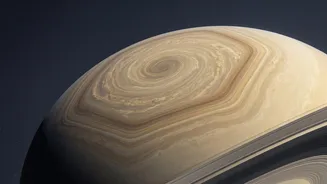
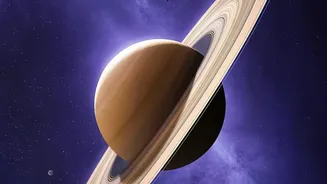
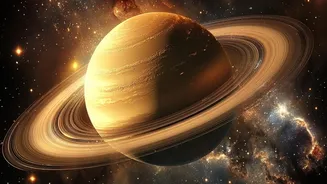
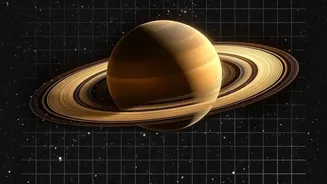
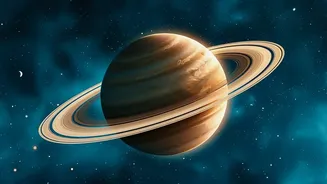
First observed by the Voyager mission in the early 1980s, the famous pattern on Saturn is a massive hexagonal jet stream encircling its north pole. This isn't a solid structure but a persistent cloud pattern with sides approximately 14,500 kilometres
long—wider than the entire diameter of Earth. The winds within this jet stream are incredibly fast, moving at about 320 kilometres per hour. Unlike storms on Earth that last for weeks, Saturn's hexagon has remained stable for decades, possibly even centuries, making it a long-standing mystery. The entire structure rotates at nearly the same rate as the planet itself, which helps it maintain its shape.
The Geometry Comes From Fluid Dynamics
The perfectly straight lines and sharp corners of the hexagon are not created by some unseen force but by the principles of fluid dynamics. The cause is believed to be an eastward-flowing jet stream that develops instabilities, causing it to meander. At certain speeds and under specific conditions, these meanders can settle into a stable, polygonal shape. The hexagon forms in a region of turbulent flow between two different rotating bodies of gas moving at dissimilar speeds. A steep gradient, or a sharp change in wind speeds at a specific latitude (about 78°N), is thought to be the key trigger that forces the jet stream into a six-sided wave pattern.
Scientists Have Recreated It in a Lab
To prove that this bizarre shape could be natural, scientists recreated the phenomenon on Earth. In laboratory experiments, researchers used a circular tank of liquid rotating at different speeds at its center and periphery to mimic the conditions in Saturn's atmosphere. This setup created instability in the fluid, which spontaneously formed vortices and settled into a stable polygon. While a hexagon was the most common shape produced, the experiments also generated patterns with three to eight sides, depending on the rotation speeds. These lab models showed that such geometric shapes are a natural outcome of the physics of rotating fluids, validating the theory that the hexagon is a giant, self-sustaining weather pattern.
The Hexagon Changes Color with the Seasons
While the shape of the hexagon is remarkably stable, its appearance is not static. Observations from the Cassini spacecraft, which studied Saturn for 13 years, revealed that the hexagon changes color with the planet's long seasons. Each season on Saturn lasts more than seven Earth years. Between 2012 and 2016, as Saturn's northern hemisphere moved from its spring towards summer, the hexagon's colour shifted from a hazy blue to a more golden hue. Scientists believe this is due to changes in solar radiation. As the pole receives more sunlight, it likely triggers photochemical reactions that create haze particles, altering the colour of the massive storm system.
The 'New' Pattern Is Actually a Southern Decagon
While the northern hexagon has been known for over 40 years, the term "new pattern" has gained fresh meaning with a discovery made between 2023 and 2025. Recent observations from the Hubble Space Telescope have revealed a similar, but distinct, polygonal shape forming at Saturn's south pole—a ten-sided feature, or decagon. This was a surprise, as the south pole previously showed no signs of such a stable structure during the Cassini mission. Unlike the long-lived hexagon, this southern decagon appears to be a more recent and evolving phenomenon, giving scientists a rare chance to watch a giant atmospheric pattern develop in real-time. This discovery suggests that such geometric storms might not be as unique as once thought.