



A Cosmic Needle in a Digital Haystack
The challenge of planetary defence is immense. Our solar system is teeming with millions of asteroids, ancient rocks left over from its formation. While most orbit harmlessly between Mars and Jupiter, some have paths that bring them close to Earth. These
Near-Earth Objects (NEOs) range from small rocks that would burn up in our atmosphere to large bodies capable of causing significant damage. Finding them is like spotting a charcoal briquette in the dead of night, millions of kilometres away. Traditionally, this meant a relentless, telescope-driven search of the skies. But as our ability to collect astronomical data has exploded, the problem has evolved. The new challenge is not just collecting observations, but making sense of the petabytes of information flowing in from sky surveys around the globe.
The Gaia Revolution: A Star Mapper's Gift
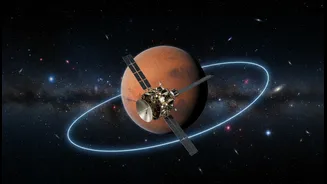
A key part of this data revolution comes from an unlikely source: the ESA's Gaia mission. Gaia's primary job is to create an ultra-precise 3D map of over a billion stars in our galaxy. To do this, it scans the sky repeatedly, measuring the exact position of stars. These stars provide a stable, near-perfect background grid. When an asteroid passes in front of this grid, its motion becomes incredibly easy to measure with high precision. By knowing exactly where the background stars are, astronomers can calculate an asteroid's trajectory more reliably than ever before. This has allowed researchers to find 'lost' asteroids from decades-old observations and dramatically refine the orbits of known ones, helping to better predict their future paths and potential risks.
Inside the Digital Toolkit
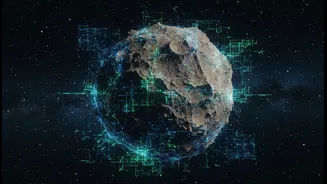
At the heart of ESA's efforts is the Near-Earth Object Coordination Centre (NEOCC), which acts as a central hub for asteroid data. It has developed a suite of freely available tools that empower a wider community of scientists and even amateur astronomers to participate in planetary defence. For instance, the Asteroid Discovery Analysis and Mapping (ADAM) platform, developed by the B612 Foundation's Asteroid Institute and used by researchers globally, is a powerful open-source cloud platform. It can sift through historical telescope archives, linking points of light from different images that are consistent with an asteroid's orbit. This 'tracklet-less' method means that data from any telescope, not just specialized survey instruments, can be used to discover new asteroids that were previously missed.
Data-Driven Defence in Action
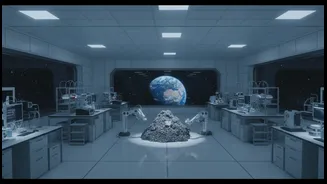
The impact of this data-centric approach is tangible. By applying advanced algorithms to massive datasets from projects like the Gaia mission, scientists can do more than just track asteroids. They can analyse how they spin and tumble, revealing clues about their internal structure—whether they are solid rocks or just loose 'rubble piles'. This is critical information for any future deflection mission, like NASA's DART experiment, as a solid body reacts differently to an impact than a pile of gravel. Furthermore, by combining new observations with precovery data—historical sightings found in archives—orbit predictions become vastly more accurate, allowing organisations like the NEOCC to confidently rule out or flag potential impacts for decades to come.