


The Hunt for Cosmic Fingerprints
In astrobiology, the clues we look for are called biosignatures. A biosignature is any substance, pattern, or object that provides evidence of past or present life. Think of them as life's fingerprints. These can range from complex organic molecules and
fossils to specific gases in a planet's atmosphere, like oxygen or methane. On Earth, the combination of abundant oxygen and methane in our atmosphere is a strong indicator of life, as these gases are constantly produced by biological processes. For space missions, identifying such signatures is the primary goal in determining if a distant world could harbor, or once harbored, living organisms. These can be categorized as chemical biosignatures, which relate to molecules and compounds, or morphological ones, which are about form and structure.
Nature's Great Impostors
The critical problem is that many potential biosignatures can also be created by non-biological, or abiotic, processes. This is the 'misleading chemistry' that can lead to a false positive—a moment of immense excitement followed by the disappointing realization that what looked like life was just geology. For instance, methane, a promising biosignature, is produced by microbes on Earth. However, it can also be generated by water-rock reactions deep underground, a completely abiotic process. Similarly, oxygen can be produced photochemically without any need for photosynthesis. The usefulness of any potential biosignature is determined not just by the likelihood that life created it, but by the improbability that it was formed by non-biological means. Scientists must therefore build a library of these 'impostors' to avoid being fooled.
The Gold Standard: Converging Evidence
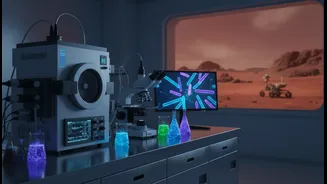
This is why the scientific community is pushing for a higher standard of proof: demanding converging evidence from independent measurements. One piece of evidence, like the detection of a single gas, is not enough. Imagine a detective at a crime scene. A single fingerprint is a good clue, but it’s not a conviction. The case becomes strong when you also have a witness, a motive, and a weapon. In astrobiology, this means a space mission's instruments must provide multiple, independent lines of evidence that all point to the same conclusion. For example, a rover might see a strange, layered rock formation (a potential morphological biosignature), and then a spectrometer on its arm could detect complex organic molecules within it (a chemical biosignature), and another instrument could find isotopic ratios indicative of biological processing. No single measurement is a smoking gun, but together, they build a powerful and convincing case.
Raising the Bar for Discovery
The stakes are incredibly high. A premature or incorrect announcement of alien life would have massive repercussions, undermining public trust in science. To prevent this, NASA and the wider astrobiology community have been developing frameworks to formalize this process, such as the 'Confidence of Life Detection' (CoLD) scale. This seven-step scale provides a clear path for evaluating evidence, from the initial detection of a potential signal to the independent confirmation required for a definitive announcement. This rigorous approach is crucial for planning future multi-billion-dollar missions to promising targets like Mars, Europa, and Enceladus. The goal is to ensure that when a discovery is announced, it is built on a foundation of solid, reproducible, and independently verified science, leaving no room for abiotic ambiguity.