



The Cosmic Communication Bottleneck
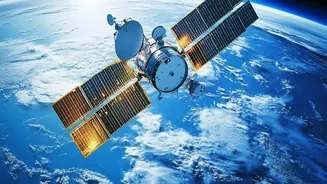
Since the dawn of the space age, missions have relied on radio frequency (RF) systems to phone home. From the Moon to the edge of the solar system, these reliable waves have carried our discoveries. However, as our ambitions grow, RF technology is becoming
a cosmic bottleneck. Missions now generate far more data than they can efficiently send back. For example, the Mars Reconnaissance Orbiter can take over seven hours to transmit a full day's worth of data. Sending high-resolution images or video becomes a slow, painstaking process. It's like trying to stream 4K video over a dial-up modem; the demand for data has simply outpaced the capacity of the infrastructure. As we plan for crewed missions to Mars, which will require streaming high-definition video and constant data exchange, it's clear that radio waves alone won't be enough.
A Beacon in the Void: How Laser Comms Work
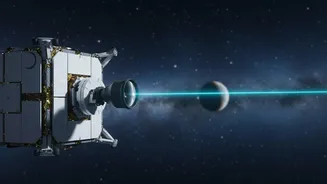
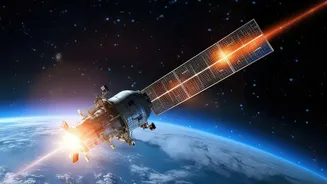
Instead of using radio waves, deep space optical communication uses lasers to encode data into photons—particles of light—and transmit them across the void. A flight laser transceiver on a spacecraft aims a highly focused, near-infrared beam at a target on Earth. That beam is captured by large, ground-based telescopes, like the Hale Telescope at Caltech's Palomar Observatory, which act as receivers. The key advantage lies in the frequency. The infrared light used operates at a frequency thousands of times higher than radio waves, allowing it to carry significantly more information in the same amount of time. This method allows for a much higher data rate, or bandwidth. Additionally, laser communication systems are smaller, lighter, and require less power than their RF counterparts—a critical advantage on any spacecraft where size, weight, and power are precious commodities.
Putting It to the Test: The Psyche Breakthrough
The headline-making claim of a 100-fold improvement isn't just theory; it has been demonstrated in space. NASA's Deep Space Optical Communications (DSOC) experiment, riding aboard the Psyche spacecraft launched in October 2023, was designed to prove this technology's readiness. The results have been spectacular. In December 2023, from a distance of 31 million kilometres, DSOC beamed a high-definition video of a cat named Taters back to Earth at a stunning rate of 267 megabits per second (Mbps)—a speed comparable to terrestrial broadband. As Psyche has traveled farther, the system has continued to break records, successfully transmitting data from over 226 million kilometres away at 25 Mbps. This test showed that laser systems can deliver data at rates 10 to 100 times greater than the state-of-the-art radio systems used by deep space missions today.
More Than Just Faster Internet for Mars
The leap in bandwidth is about more than just convenience; it's a fundamental enabler for the future of science and exploration. With laser communications, transmitting a complete, high-resolution map of Mars could take nine days instead of the nine weeks required with current RF technology. Scientists will no longer have to be so selective about the data they bring home, allowing for a more comprehensive understanding of distant worlds. For future human missions, the implications are profound. Astronauts on Mars could have reliable, high-speed links to Earth, enabling real-time video conferencing, immediate transmission of medical data, and faster mission support. This technology could transform interplanetary exploration from a series of delayed dispatches into a truly connected, interactive endeavour.
Challenges on the Horizon
Despite its immense promise, laser communication faces its own set of challenges. The laser beams are incredibly narrow, requiring pointing accuracy so precise it's like hitting a ten-cent coin from a kilometre away. Any slight jitter in the spacecraft requires a sophisticated system to keep the beam locked onto its target. Furthermore, Earth's atmosphere can interfere. Clouds, for instance, can completely block the laser signal. To mitigate this, NASA is building a network of optical ground stations in high-altitude, arid locations known for clear weather, like in California, Hawaii, and New Mexico. By having multiple receiving stations, NASA can ensure that if one location is clouded over, another might have a clear view to catch the transmission.