


In the world of yoga, some of the most profound poses are the simplest. Apanasana, often called the 'knees-to-chest' pose, is a perfect example—a deeply restorative posture that offers a wealth of benefits with minimal effort.
What Exactly Is Apanasana?
Apanasana is a gentle, supine
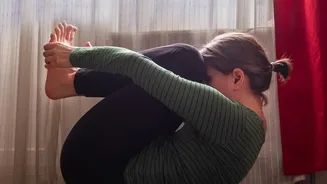
yoga posture where you lie on your back and hug your knees toward your chest. Its Sanskrit name translates to the 'Pose of Downward-Moving Energy'. 'Apana' refers to a vital life force in yogic philosophy responsible for elimination and grounding, which is why the pose is also known as the Wind-Relieving Pose. It is renowned for its ability to massage the abdominal organs, release tension in the lower back, and calm the nervous system. Commonly practised at the beginning or end of a yoga session, it's an accessible and soothing posture suitable for nearly all levels.
The Core Benefits for Body and Mind
The gentle compression of Apanasana offers significant physical and mental rewards. Physically, it provides a gentle stretch for the lower back and hips, decompressing the lumbar spine and alleviating stiffness from prolonged sitting. This action can help relieve tension associated with lower back pain and sciatica. The pose also massages the abdominal organs, which can aid digestion, relieve bloating, and ease constipation. Mentally, Apanasana is deeply calming. By activating the parasympathetic nervous system, it helps slow the heart rate, reduce anxiety, and prepare the body and mind for rest, making it an excellent pose to do before sleep.
How to Perform Apanasana: Step by Step
Finding comfort in this pose is straightforward. Start by lying flat on your back on a comfortable surface. Keep your neck long and your shoulders relaxed. On an exhale, slowly draw both knees in towards your chest. Wrap your arms around your shins, or if that’s uncomfortable, hold the backs of your thighs instead. Ensure your entire back, from your shoulders to your tailbone, remains connected to the floor. Avoid lifting your head or tensing your jaw. Breathe deeply, allowing your belly to press against your thighs with each inhale. Hold for anywhere from 30 seconds to a few minutes, focusing on the sensation of release.
The Art of the Gentle Hold
The headline's emphasis on a 'gentle hold' is crucial. The goal of Apanasana is release, not force. A tight, aggressive grip can create tension in the shoulders, neck, and arms, counteracting the pose's calming benefits. Instead of pulling your knees forcefully, think of letting gravity do the work. Your hands are there to guide and support, not to yank. Use your exhalations to soften and draw the thighs closer naturally. A gentle hold allows the hip flexors to relax and the lower back to lengthen organically. You can even introduce a soft, rhythmic movement, allowing the knees to drift away slightly as you inhale and drawing them back in as you exhale, creating a wave-like motion that further soothes the spine.
Common Misalignments and Modifications
To get the most out of Apanasana, avoid a few common mistakes. The most frequent is tensing the upper body—hunching the shoulders towards the ears or straining the neck. Consciously relax your shoulders down and away from your ears. Another is holding your breath; maintain a slow, steady rhythm. If holding both knees is difficult due to a larger belly or hip tightness, try separating your knees towards your outer ribs. For those with knee sensitivity, holding the backs of the thighs provides the same lower-back release without pressuring the knee joints. A single-leg variation, Ardha Apanasana, where one leg is extended while the other is drawn in, is also an excellent modification, especially for those with acute back pain or during the first trimester of pregnancy.