








The Physics of a Fiery Return
Returning from space isn't like a gentle descent. A capsule is travelling at immense speeds—around 28,000 km/h from low-Earth orbit and a blistering 40,000 km/h when returning from the Moon. It must shed this kinetic energy, and the fastest way is to
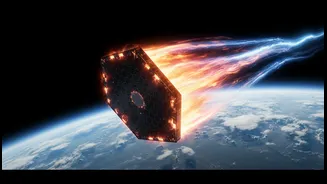
use Earth's atmosphere as a brake. But this process is incredibly violent. The spacecraft doesn't burn up from friction, as is commonly believed. Instead, it rapidly compresses the air in front of it, creating a shockwave that heats the gas to temperatures as high as 5,000 degrees Fahrenheit—roughly half the temperature of the sun's surface. This turns the air into a glowing plasma that would vaporize the capsule and its crew without a thermal protection system, or heat shield.
The Old Guard: Ablative Shields
For decades, the primary solution was the ablative heat shield. Used on missions from Apollo to the Soyuz, these shields are designed to burn away in a controlled manner. Materials like Avcoat, a fibreglass honeycomb filled with an epoxy resin, are used. As the shield heats up, the outer layers char and flake off, carrying the intense heat away from the spacecraft before it can penetrate to the structure underneath. This method is extremely effective but has a major drawback: it is a one-time-use system. The shield is destroyed during the process, making it unsuitable for the new era of rapid, reusable spaceflight that companies and space agencies are striving for.
New Missions, Extreme Demands
Upcoming missions like NASA's Artemis program, which aims to return humans to the Moon, are pushing the limits of traditional technology. The Artemis I test flight in 2022 revealed unexpected erosion on the Orion capsule's Avcoat heat shield upon its return. While NASA has determined the shield is safe for the upcoming crewed Artemis II mission with modified reentry plans, the incident highlighted the immense challenge. Returning from the Moon involves much higher speeds and greater heat loads than returning from low-Earth orbit. Furthermore, future ambitions of missions to Mars and the goal of making spaceflight more routine and affordable demand thermal protection systems that are not only robust but also reusable.
The Next Generation: PICA and TUFROC
This is where cutting-edge materials come in. One of the workhorses for modern spaceflight is PICA, or Phenolic Impregnated Carbon Ablator. Developed by NASA, PICA is a lightweight, efficient ablative material used on missions like Mars Science Laboratory and SpaceX's Dragon capsules. It's lighter and more efficient than older materials. NASA has continued to innovate with materials like Conformal PICA (C-PICA), which is being licensed to commercial companies like Varda Space Industries for their reentry capsules. For the leading edges of spaceplanes like Sierra Space's Dream Chaser, which experience even more intense, localised heat, new composites are being developed. These include silicon carbide and carbon-carbon composites, which are incredibly heat-resistant and durable, designed for many reuses.
The Starship Paradigm: Reusability Is Key
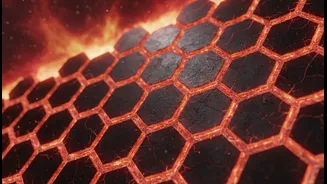
SpaceX is taking a different approach for its massive Starship vehicle, designed for full and rapid reusability. Instead of an ablative shield, Starship is covered by approximately 18,000 hexagonal tiles made of a specialised silica ceramic. These tiles are designed to work like those on the Space Shuttle, but with significant improvements for durability and easier maintenance. They are designed to radiate most of the heat away, withstanding temperatures over 3,000°F and protecting the stainless-steel structure underneath. The uniform, hexagonal shape allows for quick replacement of any damaged tiles, a key part of the vision for making Starship operate more like an airliner, with fast turnaround between flights. This reusability is seen as the key to dramatically lowering the cost of access to space.