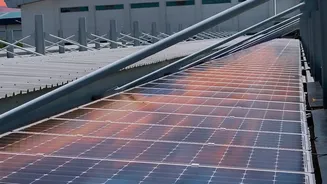









The High Cost of Heat
Solar panels and sunny, hot weather should be a perfect match. While panels do need sunlight to generate electricity, excessive heat is actually a problem. For every degree Celsius the temperature rises above the optimal 25°C, a typical silicon solar
panel loses between 0.3% and 0.5% of its efficiency. In a country like India, where summer temperatures in states like Rajasthan and Gujarat regularly soar past 45°C, the internal temperature of a solar cell can reach a staggering 70°C. This phenomenon, known as heat decay or temperature-induced degradation, means that on the hottest days, when power is needed most, solar farms can be significantly less productive, losing up to 15% or more of their potential output. This not only reduces the amount of clean energy generated but also impacts the financial viability of solar projects, a critical challenge for India's renewable energy sector.
A Solution Inspired by Skin
The inspiration for a solution comes from an unlikely source: the same pigment that colours human skin, hair, and eyes. Melanin is nature's own master of radiation management. In humans, it absorbs harmful ultraviolet (UV) rays to protect the skin. But its properties are far more diverse. Melanin is incredibly stable at high temperatures and is excellent at converting absorbed radiation into harmless heat and dissipating it. It's this combination of radiation absorption and thermal management that has captured the attention of scientists looking for new ways to protect and enhance technology. Researchers have been exploring how this natural polymer could be harnessed for everything from space exploration to electronics.
The Bio-Synthetic Breakthrough
The challenge lies in creating a practical, scalable version of melanin that can be applied to industrial assets. This is where bio-synthetic melanin comes in. Scientists have developed methods to produce melanin in the lab, creating coatings that mimic and even enhance the properties of the natural version. Recent research has focused on applying thin films of this bio-synthetic melanin to the surface of photovoltaic materials. The idea is that the melanin layer can perform several functions simultaneously. It can shield the delicate semiconductor layers within the solar cell from certain types of radiation that cause long-term degradation. More importantly for the problem of heat decay, it can help manage the thermal load, absorbing energy and dissipating it as heat more effectively, thereby helping to keep the underlying solar cell closer to its optimal operating temperature.
Implications for India's Solar Dream
For a nation targeting massive expansion of its solar capacity, this technology could be a game-changer. The performance losses due to extreme heat are a major operational and economic hurdle for solar developers in India. A coating that could mitigate even a fraction of this efficiency loss would translate into a significant increase in energy generation and revenue over the 25-plus year lifespan of a solar farm. By making solar assets more resilient to the country's climate, melanin-based coatings could improve the return on investment for new projects and make solar power more reliable, especially during peak summer demand. This kind of climate-specific innovation is precisely what is needed to ensure the long-term success and sustainability of India's green energy transition.
The Road from Lab to Rooftop
While the initial findings are promising, the technology is still in the research and development phase. The next steps will involve moving from small-scale lab experiments to real-world field tests on actual solar panels. Researchers will need to perfect the coating's formulation to ensure it is durable enough to withstand decades of exposure to the elements, from harsh sunlight and monsoon rains to dust and humidity. The cost of production and application will also be a critical factor in its commercial viability. However, if these hurdles can be overcome, bio-synthetic melanin coatings represent a powerful example of biomimicry—using nature's clever solutions to solve modern engineering challenges and unlock the full potential of solar power in the world's sunniest and hottest regions.