




A Cosmic Disappearing Act
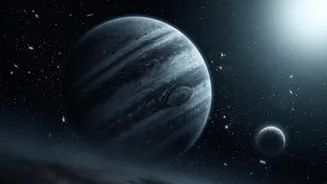
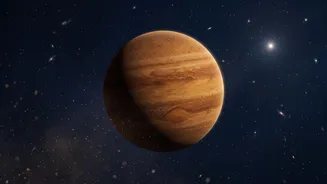
For seven years, from 2019 to early 2026, astronomers using NASA's Transiting Exoplanet Survey Satellite (TESS) kept a close eye on TOI-2535 b. This exoplanet is a 'hot Jupiter'—a massive gas giant orbiting its star at a blistering pace, completing a full
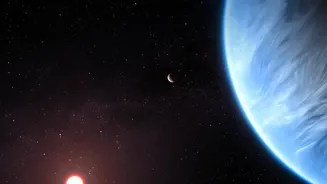
year in just over eight Earth days. Scientists detect such planets through the transit method, which involves watching for a tiny, periodic dip in a star's brightness as a planet passes in front of it from our perspective. But with TOI-2535 b, something strange began to happen. The transits grew shorter, fainter, and wildly unpredictable, sometimes arriving six hours early or late. Then, in 2026, they stopped completely. The planet, it seemed, had performed a cosmic vanishing act.
The Hidden Culprit
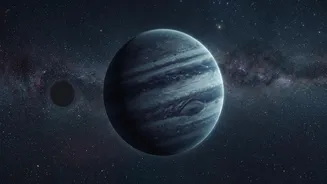
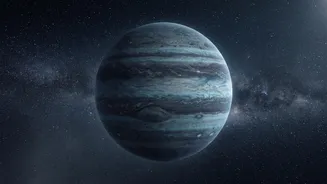
Of course, a planet the size of Jupiter doesn't simply blink out of existence. The truth, as detailed in a recent study in The Astrophysical Journal Letters, is a fascinating story of gravitational drama. The team of astronomers, led by researchers at UCLA, concluded that TOI-2535 b is not alone. Its strange behaviour is the result of a powerful gravitational tug from an unseen neighbouring planet. This hidden companion, likely at least the mass of Saturn, is pulling on TOI-2535 b, causing its orbit to precess, or wobble, much like a spinning top. This 'wobble' gradually tilted the planet's orbital plane. From our vantage point on Earth, the planet's path shifted until it no longer crossed the face of its star. So, it didn't vanish—it just moved out of our line of sight.
Why This 'Disappearance' Matters
This discovery is significant because it's the first time astronomers have directly observed a planet's transits ceasing due to such a rapid orbital shift. It's a real-time glimpse into the chaotic and dynamic nature of planetary systems, which are often less like perfect clockwork and more like complex celestial dances. This system also provides crucial clues about how hot Jupiters, which are surprisingly common, end up so close to their stars. One theory involves a violent event, like a near-collision, flinging a planet inward. Another suggests a slower, more gentle migration. The presence of two giant planets orbiting so closely together in the TOI-2535 system suggests they probably spiralled inward together over time. However, their highly tilted orbits challenge the idea that this gentle process always results in a 'flat' system, adding a compelling wrinkle to our understanding of planet formation.
What Happens Next?
The story of TOI-2535 b is far from over. While it has disappeared from view for now, the constant gravitational tango between it and its neighbour means its orbit will continue to evolve. Scientists predict that the planet's wobble will eventually bring it back into our line of sight, and we can expect its transits to resume in approximately 30 to 50 years. There's even a chance that its mysterious companion, TOI-2535 c, could have its orbit tilted into a transiting configuration even sooner. For astronomers, this system is a rare natural laboratory for studying planet-planet interactions on a human timescale. It serves as a powerful reminder that the universe is always in motion, and that even a 'disappearance' can be the start of an exciting new discovery.