
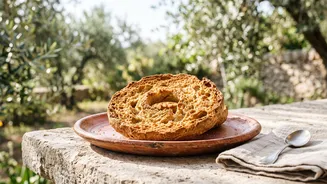
The Bread That Travels Through Time
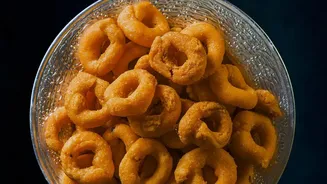
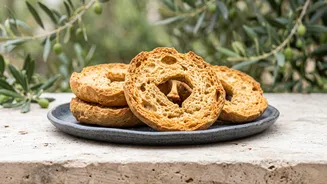
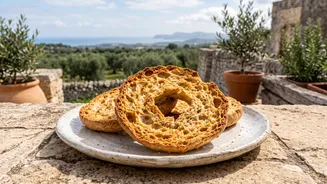
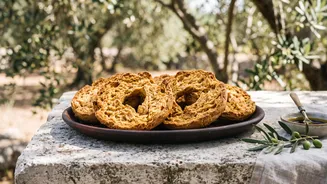
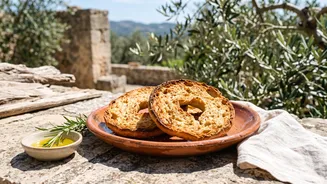
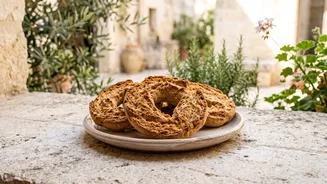
At first glance, a frisella might look like a rustic, oversized, bagel-shaped rusk. It's hard, dry, and unassuming. But this is by design. Friselle are a type of bread, traditionally made from durable durum wheat or barley flour, that is baked not once,
but twice. This double-baking process, or 'biscotto', removes almost all moisture, rendering the bread incredibly hard and shelf-stable for weeks or even months. This simple feature is the key to its entire history. Born in regions like Puglia, Calabria, and Campania, friselle were the original travel food. Long before refrigeration, they were the perfect sustenance for fishermen on long voyages and farmers or shepherds working in remote fields. Their ring shape was even a practical choice; they could be easily strung onto a rope and hung for transport and storage.
A History of Ingenuity
The origins of friselle are ancient, with some historians tracing twice-baked breads back to the 10th century, where they were a staple for merchants and military men on long journeys. They were even known as 'the bread of the Crusaders' for their reliability during long campaigns. Historically, there were often two versions: a finer one made with durum wheat for wealthier families and a more rustic one made from barley for the working class. This was not a delicacy but a cornerstone of survival. It was a food born of necessity, embodying the core principles of Southern Italian food culture: nothing is wasted, and simple ingredients are transformed with clever techniques. This tradition of practicality, making the most of what the land provides, is a thread that runs through the entire region's cuisine.
The Ritual of 'Sponzatura'
Because they are jaw-breakingly hard, friselle are never eaten dry. They must first be revived in a ritual known as 'sponzatura' or 'bagnatura', which simply means wetting. The frisella is quickly dipped in a bowl of cold water for just a few seconds—long enough to soften the interior but leave a pleasant chew and a bit of crunch at the edges. Too long and it becomes mush; too short and it remains too hard. In ancient times, fishermen would simply dip them in clean sea water, seasoning and softening the bread in one go. Once softened, the rough, porous surface of the frisella is perfect for holding toppings. The classic and most beloved preparation is simplicity itself: chopped ripe tomatoes, a generous drizzle of high-quality extra virgin olive oil, a sprinkle of oregano, and a pinch of salt.
A Canvas for Southern Flavors
While the classic tomato topping remains the favourite, especially during the hot summer months, the frisella is a versatile base for countless variations that showcase the bounty of the south. In Calabria, it might be topped with the region's famous sweet Tropea onions and a hint of chilli. Other popular additions include tuna in oil, briny capers, olives, or fresh mozzarella. It can be rubbed with a clove of garlic before wetting or topped with anything from marinated vegetables to cured meats. This adaptability is part of its charm. The frisella doesn't dominate; it supports the fresh, seasonal ingredients that are the true heart of Southern Italian cooking. It’s a simple foundation upon which the vibrant flavours of the Mediterranean are built.