


A Sweet Discovery in a Cosmic Nursery
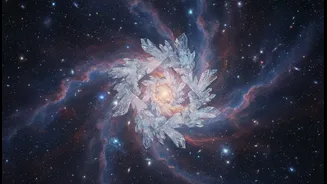
In a groundbreaking discovery, astronomers have identified a sugar molecule called erythrulose for the first time in the interstellar medium—the vast, cold space between stars. The detection was made using radio telescopes in Spain to observe a massive,
dense cloud of gas and dust known as G+0.693-0.027, located about 27,000 light-years away near the galactic core. These molecular clouds are stellar nurseries, the very places where new stars and planetary systems are born. While scientists have previously found hints of simpler sugar-like molecules in space and more complex sugars inside meteorites that have landed on Earth, this is the first definitive detection of a true sugar floating freely in one of these cosmic cradles.
More Than Just a Simple Sugar
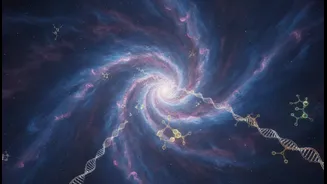
Erythrulose is what chemists call a four-carbon sugar. While you won't be stirring it into your morning coffee, its chemical structure is profoundly important. Sugars are essential building blocks for life as we know it, providing energy and forming the structural backbone of our genetic material. For example, RNA (ribonucleic acid), a molecule many scientists believe was a precursor to DNA, is built around a five-carbon sugar called ribose. The discovery of erythrulose is exciting because it demonstrates that more complex sugars can form in space. It is considered a key step on the chemical pathway to forming the ribonucleotides needed for RNA, suggesting the ingredients for life's first genetic systems are not unique to planets.
A New Recipe for Building Planets
This finding challenges and refines our theories about how planets are constructed. For a long time, scientists struggled to explain how early Earth could have produced enough sugar molecules on its own, as lab experiments simulating prebiotic conditions proved inefficient. The discovery of erythrulose in an interstellar cloud provides a compelling solution: the sugars were already present in the raw material. This supports the theory that the essential organic compounds for life are not formed on planets after they cool, but are instead “pre-loaded” into the gas and dust that collapses to form stars and their orbiting planets. The ingredients for life, it seems, are baked into the planetary recipe from the very beginning.
From Stardust to Life's First Spark
So, how does a sugar molecule in a distant cloud connect to life on Earth? The prevailing theory is that these molecules are delivered to young, rocky planets via comets and asteroids. During the early history of our solar system, an era known as the Late Heavy Bombardment, Earth was constantly pelted by these cosmic objects. Researchers estimate that up to 50 million tonnes of erythrulose could have been delivered to our planet during this period. This cosmic delivery service would have supplied early Earth with a rich inventory of prebiotic molecules, including sugars, amino acids, and other organic compounds, potentially kick-starting the chemical reactions that led to the origin of life. The detection of erythrulose strengthens the idea that the universe is chemically primed for life to emerge, not just here, but elsewhere.