





What Exactly is the SunRISE Mission?
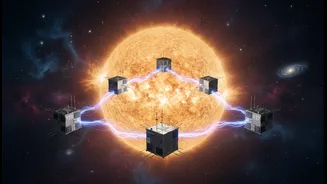
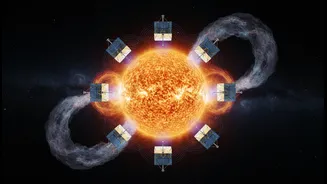
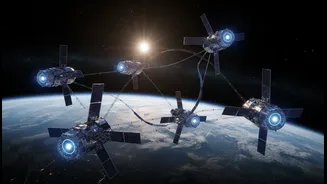
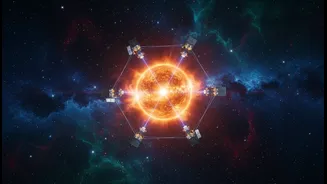
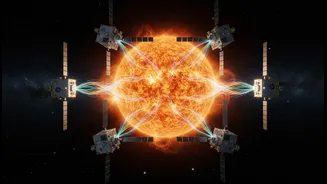
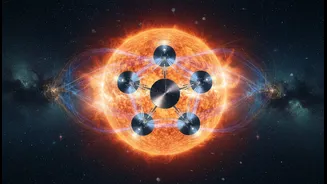
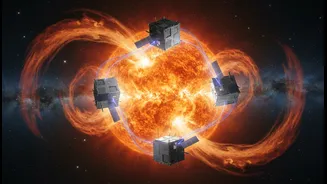
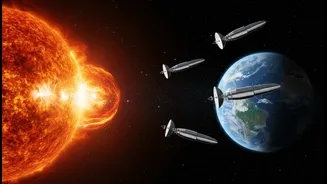
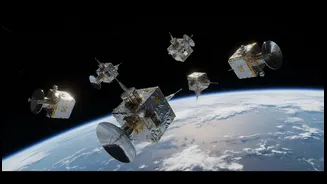
At its core, SunRISE is a constellation of six toaster-sized CubeSats that will fly in formation about 22,000 miles above Earth. Working together, they will function as one giant, virtual radio telescope stretching over six miles wide. Their goal is to capture
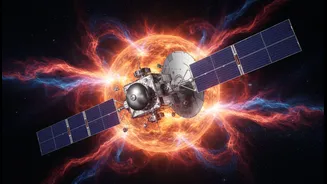
low-frequency radio waves that are generated by explosive solar events, like coronal mass ejections (CMEs). These signals are blocked by Earth's ionosphere, making them impossible to study from the ground. By placing this observatory high above the atmosphere, scientists will be able to 'see' the sun in a way they never have before, creating the first 3D maps of where these giant particle bursts originate and how they travel through space. The SmallSats have completed assembly and testing at Utah State University's Space Dynamics Laboratory and await their launch. Recently, NASA announced a change in plans, moving the mission to a SpaceX Falcon Heavy rocket to ensure it gets into orbit effectively.
For Space Readers: A New Window on the Sun
For anyone fascinated by the cosmos, SunRISE promises a dramatic new perspective on our nearest star. Currently, when a solar storm erupts, it's like seeing a flash of lightning without knowing exactly where it struck. SunRISE will change that. By using a technique called interferometry, the six spacecraft will combine their data to pinpoint the precise location of solar radio bursts. This will allow scientists to create detailed 3D maps that trace the journey of energetic particles from their origin on the sun into interplanetary space. It will also be the first mission to map the complex magnetic field lines that guide these solar storms. For space enthusiasts, this means a richer, more detailed understanding of the Sun's dynamic and often violent behavior. It will help answer long-standing questions about what makes some solar eruptions so powerful while others are relatively mild, complementing observations from other missions like the Parker Solar Probe.
For Satellite Operators: A Crucial Early Warning System
The practical implications of SunRISE are enormous, particularly for satellite operators and infrastructure on Earth. Intense solar storms release waves of energetic particles that can damage or disable satellites, disrupt GPS signals, endanger astronauts, and even knock out power grids on the ground. A key feature of these solar events is that the radio waves they generate travel at the speed of light, reaching Earth much faster than the harmful particles themselves. SunRISE is designed to detect these radio bursts as they happen. By tracking these radio signals, the mission will function as an advanced early warning system. This could give satellite operators valuable time—from minutes to hours—to put their spacecraft into a protective safe mode, or for power grid managers to prepare for potential impacts. Ultimately, better space weather forecasting protects the vital technological infrastructure that powers modern life.
For Students: Inspiring the Next Generation of Scientists
Beyond its primary scientific goals, SunRISE is a powerful tool for education and public outreach. The mission, led by the University of Michigan and managed by NASA's Jet Propulsion Laboratory, exemplifies a new, innovative approach to space exploration using small, affordable satellites. This makes it an accessible and inspiring story for students interested in STEM fields. The use of multiple CubeSats flying in a precise formation to create a virtual instrument is a cutting-edge example of distributed missions, a concept likely to become more common in the future. The data gathered by SunRISE will provide a new view of the Sun, offering rich material for classrooms and universities to study solar physics. By demonstrating how a relatively low-cost mission can tackle fundamental scientific questions, SunRISE serves as a pathfinder, encouraging a new generation to envision and build the space missions of tomorrow.