




Confronting a Cosmic Data Deluge
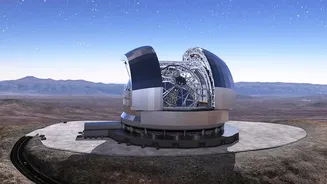
Modern astronomy is facing a challenge of its own success: a data tsunami. Telescopes like the Vera C. Rubin Observatory in Chile are set to capture the entire southern sky every few nights, generating a staggering 20 terabytes of data daily. To put that
in perspective, it would take thousands of high-definition screens just to view a single image in its entirety. Sifting through this deluge manually is not just impractical; it’s impossible. This is where artificial intelligence moves from a theoretical tool to an essential one. AI algorithms can process these massive datasets at speeds humans could never achieve, flagging points of interest and managing the torrent of information that would otherwise be lost.
The Ultimate Planet Hunters
One of the most exciting frontiers in astronomy is the search for exoplanets—worlds orbiting distant stars. Most are found using the “transit method,” which involves looking for tiny, periodic dips in a star's light as a planet passes in front of it. These signals are often buried in noisy data from missions like NASA’s Kepler and TESS. AI models, such as NASA's ExoMiner, are trained on thousands of confirmed planet signals and false positives, learning to distinguish a genuine planetary transit from a stellar flare or instrumental glitch with incredible accuracy. This automated approach has already helped confirm hundreds of new exoplanets from archival data, accelerating the discovery of new worlds and bringing us closer to understanding how common planets like Earth might be.
A Librarian for Billions of Galaxies
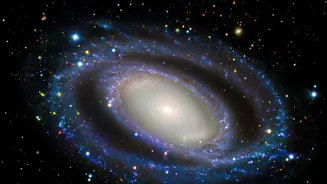
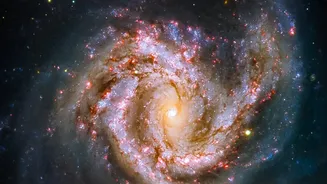
The universe is filled with countless galaxies, each a building block of the cosmos. Understanding how they form and evolve requires classifying them by shape—spiral, elliptical, or irregular. In the past, this was a painstaking process, sometimes relying on citizen science projects like Galaxy Zoo where volunteers classified images by hand. Today, AI can take on the role of a cosmic librarian. Neural networks trained on these human-classified images can now sort through millions of new galaxy images with over 98% accuracy. This automates the creation of vast, detailed maps of the universe, allowing scientists to study large-scale structures and trace cosmic history more efficiently than ever before.
Spotting the Sudden and the Strange
Perhaps AI's most powerful contribution is its ability to find the unexpected. The universe is dynamic, filled with transient events like the explosive death of a star (a supernova) or the flickering of a black hole consuming matter. These events appear and fade quickly, requiring immediate attention. Fully automated systems like the Bright Transient Survey Bot (BTSbot) can now scan nightly images, identify a potential supernova, and even trigger a robotic telescope to conduct follow-up observations to confirm the discovery—all without human intervention. Beyond finding what we expect, AI excels at anomaly detection—flagging anything that doesn’t fit known patterns. This capability opens the door to discovering entirely new types of cosmic phenomena that scientists hadn't even thought to look for.