





The Making of an Astronaut
Anil Menon’s journey to the stars is a story of remarkable dedication and diverse expertise. Born in Minneapolis, Minnesota to Indian and Ukrainian immigrants, his path has been anything but ordinary. With a degree in neurobiology from Harvard, a master's
in mechanical engineering and a medical degree from Stanford, Menon uniquely combines the worlds of medicine and engineering. Before being selected in NASA's 2021 astronaut class, he honed his skills as an emergency physician, a US Air Force colonel, and a first responder in disasters like the 2010 Haiti earthquake. His experience is deeply rooted in human spaceflight; he served as a NASA flight surgeon for ISS expeditions and was SpaceX’s first-ever flight surgeon, building their medical program and supporting the historic Demo-2 mission that first sent humans to space in a private vehicle. This unique blend of skills makes him exceptionally qualified for a mission where the primary subject of study is the astronaut's own body.
The Gruelling Reality of Zero-G
Eight months orbiting Earth is not a vacation. The absence of gravity, or microgravity, wreaks havoc on the human body, which is exquisitely adapted to life on Earth. Without the constant pull of gravity, muscles used for posture and walking begin to weaken and waste away, a condition known as atrophy. Bones, no longer needing to support weight, can lose density at a rate of over 1% per month, increasing the risk of fractures upon return. Fluids in the body shift upwards, causing a puffy face, sinus congestion, and potential vision problems known as Spaceflight-Associated Neuro-Ocular Syndrome (SANS). The cardiovascular system also deconditions, as the heart doesn't have to work as hard to pump blood. Astronauts combat this with a rigorous two-hour daily exercise regimen, but these countermeasures are themselves a subject of study.
A Laboratory in Orbit
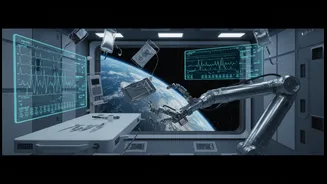
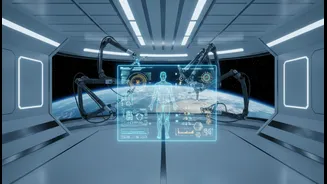
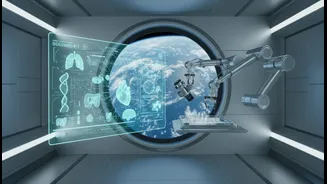
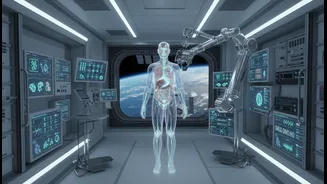
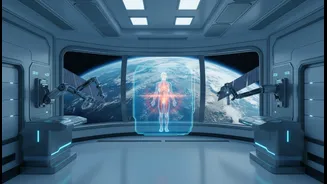
Menon and his crewmates won't just be surviving; they will be the primary subjects of a battery of scientific experiments. A key part of his mission is to study these very physiological changes to help NASA prepare for future long-duration missions to the Moon and Mars. His research will examine how microgravity impacts vein structure and blood flow. He will also test cutting-edge medical technologies, such as a device that can produce intravenous (IV) fluids from the station's drinking water, a capability that could be lifesaving on deep-space missions where carrying supplies is difficult. Another experiment involves using AI-powered ultrasound, which could allow astronauts to perform complex medical diagnostics without real-time guidance from Earth—a crucial step for missions where communication delays are significant.
A Mind in Isolation
The challenges are not just physical. Living for eight months in a confined space, isolated from family and the world, presents profound psychological hurdles. Astronauts face the constant risk of monotony, disrupted sleep cycles due to the lack of a normal day-night rhythm, and the pressure of performing complex, high-stakes work. Maintaining morale, focus, and positive group dynamics is critical to mission success. NASA invests heavily in psychological support and training to equip astronauts with coping mechanisms for stress, anxiety, and interpersonal conflict that can arise in such an extreme environment. Part of the ongoing research on the ISS is to better understand these psychological effects to ensure crews on even longer journeys to Mars are mentally and emotionally prepared for the trip.