





Understanding the 'Desk Slump'
When you sit for extended periods, your body adapts in ways that cause strain. Your hip flexors shorten, your glutes can weaken, and your upper back tends to round forward as you lean toward your screen. This classic 'desk posture' places stress on your spine,
leading to chronic discomfort and muscle imbalances that can affect your well-being both in and out of the office. The key to fighting this is not necessarily intense exercise, but frequent, targeted movement throughout the day to awaken dormant muscles and relieve tension.
Seated Cat-Cow for Spinal Flexibility
This gentle movement helps to wake up your spine and relieve back tension. Sit tall on the edge of your chair with both feet flat on the floor. On an inhale, arch your back, push your chest forward and look up toward the ceiling (Cow pose). On an exhale, round your spine, tuck your chin to your chest, and let your shoulders curve forward (Cat pose). Flow between these two positions for 8-10 repetitions, coordinating the movement with your breath to improve spinal mobility.
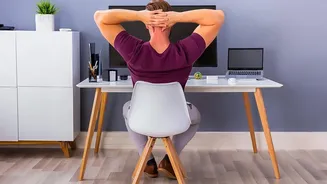
Thoracic Spine Extension Over Your Chair
This exercise directly counteracts the forward hunch. Sit upright and place your hands behind your head, elbows pointing outwards. Keeping your lower back relatively still, gently arch your upper and mid-back over the top of your chair, looking up at the ceiling. You should feel a stretch across your chest and upper back. Hold for 5 seconds before returning to the starting position. Repeat this movement 10 times to help restore mobility to the part of your spine that gets rigid from sitting.
Chin Tucks for Neck Alignment
Forward head posture, or 'text neck', is a common result of staring at screens. Chin tucks help strengthen the deep neck muscles to correct this. Sit or stand tall, looking straight ahead. Gently pull your head straight back, as if you are trying to make a double chin, without tilting your head up or down. You should feel a gentle stretch at the back of your neck. Hold the position for 3-5 seconds and then relax. Aim to perform 10-15 repetitions to help realign your head over your shoulders.
Chest Opener Stretch
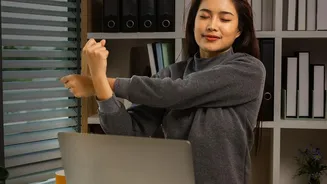
Sitting with rounded shoulders causes the muscles in your chest to become tight. This simple stretch helps to open them up. You can do this either sitting or standing. Clasp your hands together behind your back. Straighten your arms and gently pull your shoulder blades together, lifting your chest proud. If you can, lift your hands slightly away from your lower back to deepen the stretch. Hold for 20-30 seconds while taking deep breaths. This move is excellent for reversing the slumped-forward posture.
Seated Spinal Twist
Twists are fantastic for releasing tension in the lower back and improving rotational mobility. Sit upright in your chair with your feet flat on the floor. Gently twist your torso to the right, placing your left hand on your right knee and your right hand on the back or armrest of the chair for support. Use your arms to gently deepen the stretch, keeping your back straight. Hold for 15-30 seconds, breathing evenly, then slowly return to the center and repeat on the left side.