





A Leap Towards Manned Missions
The Indian Space Research Organisation (ISRO) has achieved a crucial victory on the path to its first human spaceflight mission. The agency successfully conducted a high-altitude abort test for the Gaganyaan spacecraft's Crew Escape System (CES). This
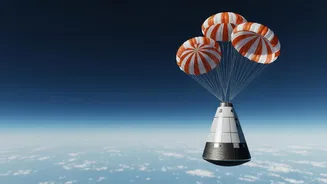
test is designed to prove that astronauts can be safely carried away from the rocket in the event of a catastrophic failure during the ascent phase of the launch. During the meticulously planned trial, a test vehicle simulating the conditions of a real launch reached a specific altitude and speed. The abort sequence was then deliberately triggered, firing powerful, quick-acting solid motors to pull the uncrewed crew module away from the rocket with immense force. The module then followed a planned descent, deploying its parachutes to slow down for a safe splashdown, where recovery teams were on standby. This successful demonstration is not just a technicality; it's a vital confidence-booster for the entire Gaganyaan programme.
The Ultimate Eject Button
Think of the Crew Escape System as the most sophisticated and powerful ejector seat ever built. Its sole purpose is to ensure astronaut survival above all else. Human space missions are inherently risky, especially during the first few minutes of flight when the rocket is a controlled explosion of immense power. If something goes wrong—a loss of thrust, a structural failure, or a deviation from the flight path—the CES must act in milliseconds. Positioned at the very top of the massive HLVM3 rocket, the system uses a series of high-burn-rate solid motors to generate enormous acceleration, literally ripping the crew capsule off the failing launch vehicle and propelling it to a safe distance before it can be caught in any potential explosion. From there, a separate set of parachutes deploys to ensure the crew returns to Earth safely. This system is non-negotiable for any nation serious about human spaceflight, representing the ultimate promise of safety to the individuals strapped inside.
Why High-Altitude is Harder
ISRO has previously tested the escape system's capabilities in a 'Pad Abort Test' in 2018, which simulated an emergency on the launchpad before liftoff. This new high-altitude test, however, is a far more complex challenge. Aborting a mission mid-flight, when the rocket is travelling at supersonic speeds and experiencing intense aerodynamic forces, presents a different set of problems. The system has to function perfectly in a much thinner atmosphere and at much higher velocities. It must not only pull the crew module clear but also ensure it remains stable during its violent separation and subsequent re-entry. Successfully demonstrating this capability shows that the escape system is robust enough to handle emergencies at various stages of the atmospheric ascent, arguably the most dangerous part of the entire journey into orbit.
The Gaganyaan Roadmap
This successful test is one of the final, critical pieces of the Gaganyaan puzzle. The programme has been methodically ticking off major milestones. Development and ground testing of the human-rated LVM3 rocket (HLVM3) have been completed. Propulsion systems for the crew and service modules have been qualified, and the all-important parachutes for a safe landing have undergone extensive integrated drop tests. The astronaut candidates, known as Vyomanauts, have completed generic training in Russia and are now undergoing mission-specific training in Bengaluru. Before the first crewed flight, which is targeted for 2027, ISRO will conduct a series of uncrewed missions to validate every system in real-world conditions. The first of these uncrewed orbital flights, G1, will even carry a humanoid robot named 'Vyommitra' to simulate the human presence and gather vital data.
India Joins an Elite Space Club
With the success of the high-altitude abort test, India moves ever closer to joining the elite club of nations—currently only Russia, the United States, and China—that possess the indigenous capability to launch their own astronauts into space. The Gaganyaan mission is more than just a scientific endeavour; it is a statement of national ambition, technological prowess, and a commitment to exploring the final frontier. The objective is to launch a crew of three into a 400 km orbit for a mission lasting several days before bringing them safely back to Earth for a splashdown in Indian waters. Each successful test brings India closer to that historic moment, paving the way for future projects like the Bharatiya Antariksha Station (Indian Space Station) and even more ambitious crewed missions.