




The Power of Monsoon Rivers
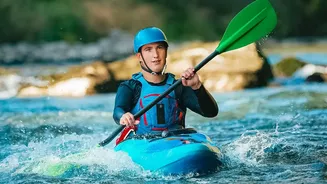
During the monsoon, Meghalaya's rivers are nothing like their calm, crystal-clear winter versions. Rivers like the Umngot and Kynshi swell with staggering volumes of water, creating Class IV and V rapids that attract international athletes. This isn't
a gentle float; it's a battle against powerful hydraulics, whirlpools, and unpredictable currents created by the region's steep gradients. The sheer force of the water can shift giant boulders and dramatically alter the riverbed overnight, meaning a familiar route can present entirely new hazards without warning. This environment is strictly for expert paddlers who can read the complex and fast-changing water conditions.
Understanding Swift-Water Hazards
Swift water presents a unique set of dangers that every expert kayaker must be trained to identify. "Strainers"—fallen trees or debris that allow water to pass through but can trap a person or a boat—are a common and deadly hazard. Undercut rocks, where the current flows underneath the rock face, can pin a swimmer with incredible force. The hydrology of a monsoon-fed river is complex and powerful. What may look like a simple wave can be a 'hydraulic' or 'hole' that can trap a kayaker indefinitely. Recognizing these features from upstream and knowing how to navigate around them is a fundamental survival skill.
The Necessity of Formal Rescue Training
This is where the headline’s warning becomes critical. Self-taught skills are not enough. A formal Swift-Water Rescue (SWR) or Whitewater Rescue Technician (WRT) certification is non-negotiable. These courses, offered by professional organisations in India, provide hands-on training in essential life-saving techniques. You learn fundamentals like self-rescue, including how to swim defensively on your back with feet pointed downstream to fend off rocks, and when to switch to aggressive front-crawl swimming to reach safety. You also practice team-based rescues using throw bags and 'live bait' techniques, where a rescuer is tethered to assist a swimmer. These are skills that must be drilled until they become instinct.
Gearing Up for the Worst-Case Scenario
Standard recreational gear is inadequate for Meghalaya's monsoon rivers. Your equipment is your lifeline. This means a high-quality whitewater-specific helmet and a buoyancy aid (or personal flotation device) with a quick-release harness system are essential. This harness is crucial for certain tethered rescue situations. You must carry a throw bag with a high-floating rope, a river knife accessible with one hand to cut a rope in an emergency, and a whistle for signaling. Every piece of gear must be in excellent condition, as equipment failure in a powerful rapid can have catastrophic consequences.
Planning, Teamwork, and Knowing When to Quit
The final layer of preparation is mental and logistical. This includes rigorously checking weather forecasts and being aware that river levels can rise exponentially and without warning due to rain upstream. Never paddle alone. Your team should be comprised of equally skilled and prepared paddlers who you trust. Have a clear plan, communicate constantly, and, most importantly, have the humility to walk away. If conditions seem too dangerous, if a team member is not feeling confident, or if the risk feels too high, the bravest decision is to portage (carry your boat around a rapid) or call off the trip entirely. Local guides possess invaluable knowledge of flash-flood patterns and river behaviours.