




More Than Just a Pretty Picture
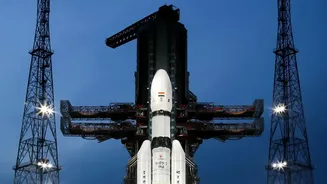
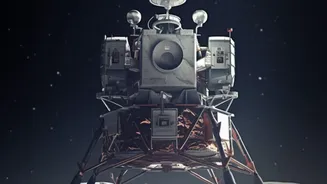
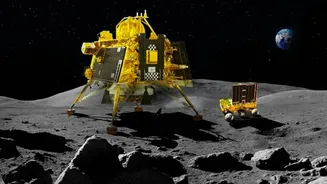
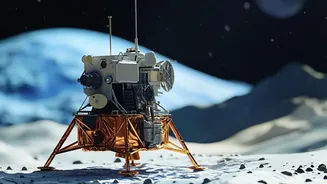
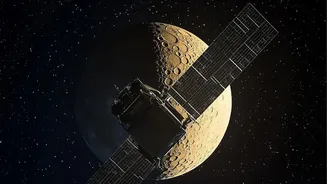
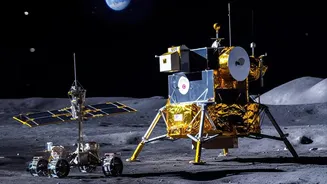
India’s Chandrayaan-3 mission captured the nation's heart with its successful soft landing near the lunar south pole, a moment of immense national pride. But while the Vikram lander and Pragyan rover were on the surface, the propulsion module that carried
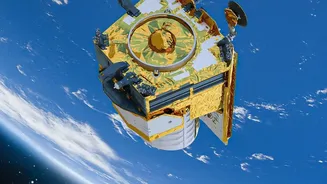
them remained in orbit with a special task. It turned its gaze back towards our vibrant, blue planet. This was not for a simple cosmic selfie. Onboard was a sophisticated instrument called SHAPE, or Spectro-polarimetry of Habitable Planet Earth. Its purpose was to study Earth from afar, treating it as a proxy for a distant, potentially habitable exoplanet. This was a crucial secondary objective, designed to test technologies that could one day help us find life elsewhere in the universe.
The Science of SHAPE
So, what is spectro-polarimetry? Let's break it down. Spectroscopy is the study of how light interacts with matter. By analysing the spectrum of light reflected from a planet, scientists can identify the chemical signatures of its atmosphere, such as the presence of gases like oxygen or water vapour. Polarimetry, on the other hand, measures the polarisation of light. Think of it like special sunglasses that filter light, revealing details you would not otherwise see. When sunlight reflects off a planet's atmosphere, oceans, or land, it becomes polarised. The characteristics of this polarisation can tell scientists about clouds, aerosols, and even the presence of liquid water. The SHAPE payload combined these two powerful techniques to capture a multi-layered portrait of Earth, analysing the 'signature' of our habitable world.
A Unique Lunar Vantage Point
We have thousands of satellites orbiting Earth, so why observe it from nearly 400,000 kilometres away? The Moon offers a unique perspective. Satellites in low-Earth orbit are too close to see the entire planet at once, while most geostationary satellites are fixed over one point. From lunar orbit, however, Chandrayaan-3 could observe the entire sunlit disk of Earth. This full-planet view is crucial because it mimics how we see a distant exoplanet through a telescope—as a single, unresolved point of light. By studying the combined light from Earth’s diverse surfaces like oceans and continents and its dynamic atmosphere, SHAPE collected a benchmark dataset. This data essentially represents the 'fingerprint' of a known life-bearing planet, which will serve as a vital reference for future searches.
Paving the Way for Exoplanet Science
The observations made by the SHAPE payload are a vital contribution to one of modern astronomy's most exciting fields: the search for extraterrestrial life. The primary goal was to characterise the spectro-polarimetric signatures of Earth as it rotated, showing different features to the instrument. By observing these changes over time, ISRO scientists can build a robust model of what a habitable planet looks like from a great distance. This model will be an invaluable reference for future, more powerful telescopes designed to hunt for Earth-like worlds. The data helps scientists understand which biosignatures—indicators of life, like oxygen and methane—are most detectable and how they might be distinguished from non-biological phenomena. In essence, Chandrayaan-3 used Earth as a celestial laboratory to perfect the techniques that will be deployed in the search for another pale blue dot in the vastness of space.