





Sailing on Sunbeams
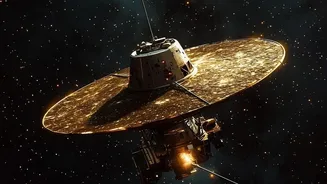
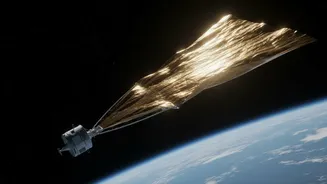
The concept of a solar sail is elegantly simple. Instead of being pushed by wind, a spacecraft with a large, reflective sail is pushed by sunlight. Sunlight is made of particles called photons, which have momentum. When these photons strike a mirror-like
sail and bounce off, they transfer a tiny amount of that momentum, creating a gentle but continuous push. This constant acceleration, without the need for heavy and finite rocket propellant, allows a spacecraft to build up incredible speeds over time. Missions can operate indefinitely, limited only by the durability of the sail materials themselves.
The Trouble with Traditional Sails
Early solar sail designs, while functional, faced significant limitations. Missions like Japan's IKAROS and The Planetary Society's LightSail 2 proved the concept but also highlighted the challenges. Sails were often made of metallised plastic films like polyimide, which had to be incredibly thin—just a fraction of the width of a human hair—to be light enough. The bigger issue was often the support structure. The long booms needed to hold the sail taut were typically metallic, making them heavy. These metal booms could also warp unpredictably due to the extreme temperature swings between scorching sunlight and the cold of space.
A Breakthrough in Materials
The latest innovation lies not in the sail itself, but in the structures that support it. NASA's Advanced Composite Solar Sail System (ACS3) mission is demonstrating the power of advanced polymers and composite materials. The mission, which launched in 2024, features booms made from a flexible polymer material reinforced with carbon fibre. This composite material is a game-changer: it is 75% lighter than previous metallic booms and is designed to experience 100 times less thermal distortion, meaning it won't warp under intense heat. This allows the booms to be strong and stable while being light enough to be coiled into a package the size of a small microwave for launch.
Unlocking Faster, Bolder Missions
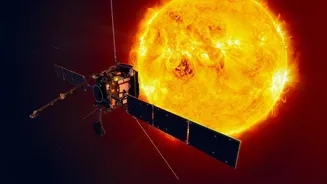
Lighter, more stable booms allow for much larger sails. While the ACS3 sail is about the size of a small apartment, the technology it's testing could be scaled up for sails as large as a basketball court or even larger in the future. A larger sail captures more photons, generating more thrust and enabling faster acceleration. This opens up entirely new mission possibilities. Spacecraft could perform a “slingshot” maneuver, diving close to the sun where the sunlight is most intense for a massive speed boost, reaching velocities far beyond what chemical rockets can achieve. A trip to the outer planets that currently takes years could be cut down to just months.
The Future of Deep-Space Exploration
The successful demonstration of these advanced polymer composites is a critical step toward a new era of space exploration. Future missions could include near-Earth asteroid reconnaissance, communications relays for crewed missions to Mars, and advanced space weather satellites. By placing observatories closer to the sun, solar sails could provide earlier warnings of solar storms that threaten power grids and satellites on Earth. Other research is exploring even more exotic materials, like graphene-polyimide composites, which could further improve heat resistance and mechanical strength, allowing sails to get even closer to the sun for maximum acceleration. This technology reimagines space travel, making it more sustainable, cost-effective, and ambitious than ever before.