



The Old Story of the Rings
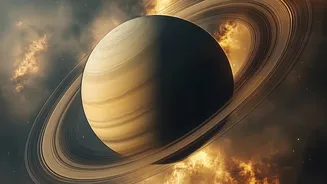
For centuries, astronomers assumed Saturn's rings were as old as the planet itself, forming some 4.5 billion years ago from the same primordial cloud of gas and dust. This was the long-held scientific consensus. The rings were seen as a stable, majestic,
and ancient feature of our solar system. Their sheer scale and breathtaking beauty, first glimpsed by Galileo in 1610, suggested they were a permanent fixture. This theory made intuitive sense; they seemed as fundamental to Saturn as oceans are to Earth. For much of modern astronomy, the debate was less about if they were old, but more about the precise mechanics of their ancient formation. This picture of a static, primordial ring system, however, began to crack under the weight of new evidence.
Clues from a Doomed Spacecraft
The game-changer was NASA's Cassini spacecraft. After a 13-year mission studying the Saturnian system, Cassini performed a daring series of 22 dives between the planet and its rings in 2017, known as the "Grand Finale". These final orbits allowed scientists to measure the rings' mass with unprecedented accuracy. The findings were startling: the rings were far less massive than predicted. A less massive ring is a 'cleaner' ring, picking up less cosmic dust and debris over time. Their surprising brightness and near-pure water-ice composition suggested they couldn't have been around for billions of years, as they would have been darkened and polluted by a constant bombardment of micrometeoroids. This pointed to a radical new conclusion: the rings must be young.
Young, Bright, and Fleeting
Just how young is a matter of intense scientific debate, but the estimates are stunning. Data from Cassini and subsequent studies suggest the rings may be no older than 100 to 400 million years. This means they likely formed around the time dinosaurs roamed the Earth. If humanity had developed telescopes in that era, we would have seen a Saturn without its iconic halo. This 'young ring' model has gained significant traction, but even it is not without challengers. Some recent computer models propose mechanisms that could keep the rings 'clean', allowing for an older age. One 2024 study suggests micrometeoroids might vaporize on impact, leaving little residue and keeping the rings pristine, potentially pushing their age back into the billions of years. This back-and-forth highlights how active and exciting this field of study is.
The Mystery of 'Ring Rain'
Adding to the drama is the discovery that the rings are actively disappearing. Scientists have confirmed a phenomenon known as 'ring rain', where icy particles from the rings are pulled inward by Saturn's gravity and magnetic field, raining down into the planet's upper atmosphere. The rate is astonishing; observations suggest an amount of water equivalent to an Olympic-sized swimming pool is lost from the rings every half hour. Based on this downpour, the entire ring system could be gone in as little as 100 million years—a mere blink of an eye in cosmic terms. We are therefore incredibly fortunate to be living in the brief window of cosmic history when Saturn has its magnificent rings at all.
A Violent Birth
If the rings are young, they must have been created by a relatively recent cataclysmic event. The leading theories centre on destruction. One popular hypothesis suggests the rings are the remains of a large, icy moon—dubbed 'Chrysalis'—that strayed too close to Saturn and was torn apart by the planet's immense tidal forces. Simulations in 2022 supported this idea, suggesting the moon was shattered, with most of it falling into Saturn and the icy remnants forming the rings. A newer, competing theory from 2026 suggests this rogue moon didn't get ripped apart by Saturn, but instead crashed into Titan, Saturn's largest moon. This mega-collision would have triggered a chain reaction, shattering other inner moons and creating the debris field that became the rings we see today.