

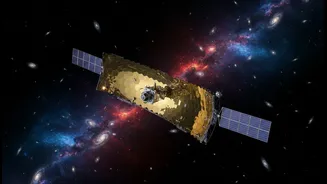
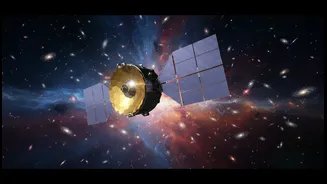
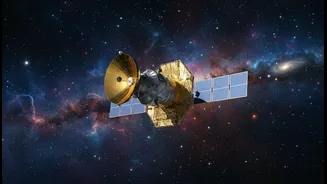


A New Chapter in Cosmic Exploration
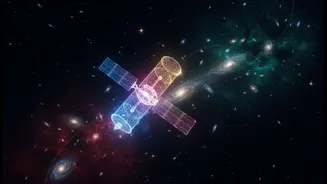
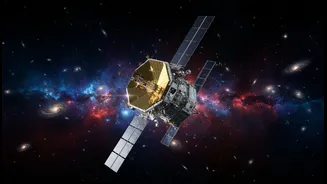
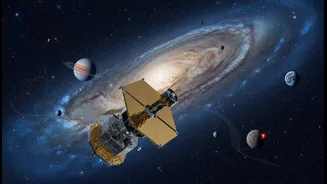
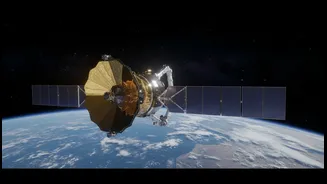
Scheduled for launch on August 30, 2026, aboard a SpaceX Falcon Heavy rocket, the Nancy Grace Roman Space Telescope represents the next generation of space observatories. Named after NASA's first chief of astronomy, the 'Mother of Hubble', this mission
isn't just a successor to its famous predecessors; it's a completely different kind of beast. While Hubble and Webb are designed to stare deeply into small patches of sky for long periods, Roman is built for speed and breadth. Its primary goal is to conduct massive surveys, mapping huge swathes of the universe in infrared light with incredible precision. This new approach will tackle some of the most profound questions in astrophysics, including the nature of dark energy and dark matter, while also conducting a massive census of planets beyond our solar system.
The Power of a Panoramic View
Roman's standout feature is its colossal field of view. Its Wide Field Instrument (WFI) can capture an area of the sky at least 100 times larger than Hubble or Webb in a single snapshot, all while maintaining a similar, razor-sharp image quality. To put it in perspective, where Hubble might need hundreds of individual images to map a nearby galaxy, Roman could do it in just a couple. This panoramic capability is what makes it a survey powerhouse. It will generate unprecedented amounts of data, creating the largest-ever cosmic maps. This wide-angle approach is essential for studying the large-scale structure of the universe and for finding rare, fleeting events that would otherwise be missed by narrow-field telescopes. Roman is not designed to see deeper than Webb, but to see wider, providing context and a wealth of new targets for other telescopes to investigate in more detail.
Unmasking Dark Matter's Secrets
One of Roman's key objectives is to illuminate the nature of dark matter, the mysterious substance that makes up about 85% of the matter in the universe. While we can't see it directly, we can see its effects. Roman will use a technique called gravitational lensing to map its presence. The immense gravity of massive objects like galaxies and clusters of dark matter can bend and magnify the light from objects behind them, acting like a natural cosmic telescope. Because of its wide view, Roman is expected to find over 160,000 of these gravitational lenses. By studying how the light from distant galaxies is distorted, astronomers can precisely measure the distribution of mass—both visible and dark—in the foreground. This will reveal how dark matter is clumped together, offering crucial clues to its fundamental nature.
A Galactic Planet Census
The hunt for exoplanets is about to get a major upgrade. Astronomers expect Roman to discover a staggering 100,000 new planets, a massive leap from the thousands found to date. It will do this using two primary methods. The transit method, which looks for the tiny dimming of starlight as a planet passes in front of its star, is expected to find the bulk of these worlds. More uniquely, Roman will be a master of gravitational microlensing. This technique spots the brief brightening of a distant star when a closer star and its planets pass in front, their combined gravity magnifying the background light. Microlensing is sensitive enough to find planets as small as Mars and even so-called rogue planets that wander the galaxy untethered to any star—worlds that are nearly impossible to find with other methods.
Mapping Cosmic Evolution
Beyond dark matter and exoplanets, Roman's expansive galaxy surveys will provide a detailed 3D map of the universe, helping us understand its evolution. By observing millions of galaxies at various distances, astronomers will be able to look back in time and trace how cosmic structures like galaxy clusters have grown and changed over billions of years. These observations will also help pin down the properties of dark energy, the enigmatic force causing the expansion of the universe to accelerate. The telescope’s ability to survey huge numbers of galaxies will give scientists the statistical power needed to test our fundamental theories of cosmology. The sheer volume of data from Roman will be a treasure trove for astronomers for decades, sparking new questions and discoveries across nearly every field of astrophysics.