






The New Digital Colleague
Imagine a tireless assistant that can draft a week's worth of science lessons, create a quiz on Indian history, or suggest activities for students with different learning styles, all in a matter of minutes. This is the promise of AI lesson planners. Teachers
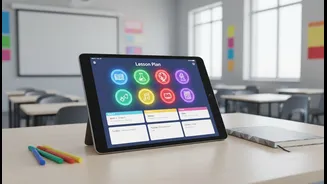
begin by providing a prompt to an AI tool, specifying the grade level, subject, learning objectives, and desired activities. The AI then processes this request and generates a structured plan, complete with outlines, discussion questions, and even assessment materials. Tools like ChatGPT, Eduaide.AI, and Magic School are becoming common names in staff rooms, offering a starting point that was once the product of hours of manual work. This isn't about replacing teachers, but rather augmenting their abilities, providing a digital thought partner to help brainstorm and structure educational content.
Reclaiming Time for What Matters
The most celebrated benefit of AI in lesson planning is the immense time savings. Teachers regularly report spending five to eight hours a week just on planning. Recent studies and surveys show that AI can slash this preparation time significantly, with some educators reclaiming several hours each week. One high school teacher noted she saves seven to eight hours weekly, which she describes as having a "thought partner" that reduces the mental and emotional tax of the job. This reclaimed time is not for idleness; it's being reinvested where it counts most. With administrative burdens lightened, teachers can devote more energy to one-on-one student interaction, mentoring, and focusing on the uniquely human aspects of teaching that no algorithm can replicate. Some studies suggest that since incorporating AI, a majority of educators feel less burned out and more in control of their workload.
Personalised Learning at Scale
Every classroom is a diverse ecosystem of learners. Differentiating instruction to meet every student's needs is a long-held goal of educators, but it is incredibly time-consuming to achieve. AI offers a powerful solution by helping teachers personalize content at scale. An AI tool can be prompted to modify a single lesson plan for various reading levels, suggest enrichment activities for advanced students, and provide scaffolding for those who are struggling. For example, it can generate reading passages on the same topic at multiple complexity levels or suggest different ways to assess understanding, from a standard test to a creative project. This allows teachers to move closer to the ideal of tailored education, ensuring every student is appropriately challenged and supported.
A Tool, Not a Panacea
Despite the excitement, experts caution that AI is not a silver bullet. A major concern is the quality and nature of AI-generated content. Without careful guidance, these tools can produce generic, uninspired lesson plans that focus on lower-order skills like memorization instead of fostering critical thinking and creativity. One study found that AI-generated civics lessons were often conventional and failed to include diverse perspectives. Furthermore, AI models can be prone to errors or 'hallucinations,' presenting factually incorrect information with convincing confidence. This places a significant burden on the teacher to act as a vigilant editor, fact-checking and refining the output to ensure its accuracy and pedagogical soundness. Over-reliance on these tools also risks deskilling educators, eroding the professional craft of instructional design over time.
The Path Forward: Human-Centred AI
The consensus among educators is clear: AI should be a co-pilot, not the pilot. Its effective use depends entirely on the teacher's expertise. The process is interactive; it begins with crafting a specific, detailed prompt, followed by a critical review of the AI's draft. The final step is for the teacher to customize and enrich the plan, infusing it with their knowledge of their students' interests, cultural backgrounds, and unique classroom dynamics—contextual layers that an algorithm cannot comprehend. As schools across India and the world continue to integrate technology, the focus remains on preparing students for an AI-driven future by developing skills like critical thinking and creativity that machines cannot yet replicate. The goal is to use AI not just to teach faster, but to facilitate deeper, more engaging, and more humane learning experiences.