


The Solar System's Most Famous Storm
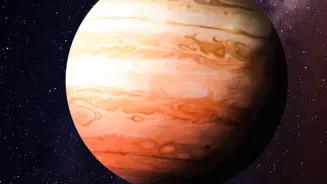
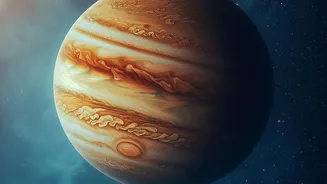
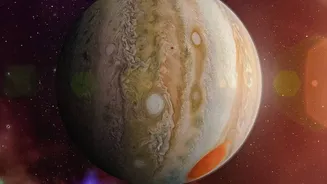
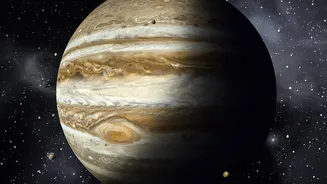
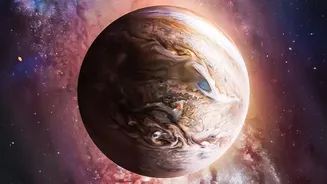
For at least 150 years, and possibly much longer, astronomers have been captivated by a persistent, crimson-coloured storm churning in the southern hemisphere of Jupiter. This Great Red Spot is an anticyclone, a high-pressure system so vast that our entire
planet could fit inside it. Unlike hurricanes on Earth that are powered by warm ocean water and die out over land, this Jovian tempest has no solid surface to slow it down, allowing it to rage for centuries, trapped between two powerful jet streams. Its sheer longevity has made it a subject of intense study and speculation: What powers it? What gives it its signature colour? And is it, as recent observations suggest, finally running out of steam?
A New, Unsteady Picture Emerges
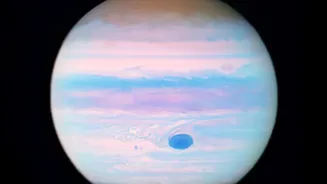
While we have been watching the Great Red Spot shrink for decades, the latest observations have revealed a completely unexpected behaviour. Using the incredible capabilities of the Hubble Space Telescope, scientists have captured imagery showing the storm is not as stable as once thought. In a series of observations, astronomers were stunned to see the storm 'jiggling like a bowl of gelatin'. The new data, assembled into a time-lapse, shows the gigantic storm is oscillating in size and shape—squeezing in and out while its rotational speed also varies. This is a dynamic behaviour that has never been identified before, challenging existing models of the storm's mechanics.
The Technology Behind the Discovery
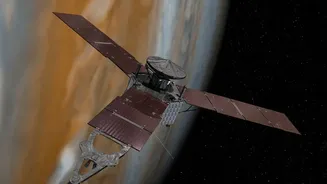
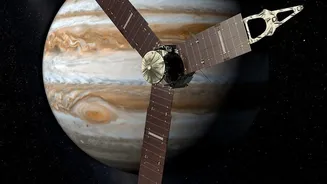
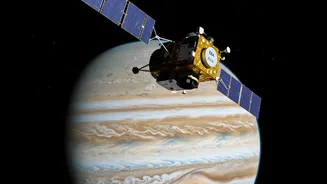
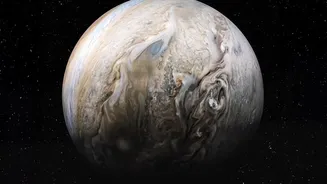
This fresh insight is thanks to dedicated observation programs that use advanced instruments to get a detailed view. The Hubble Space Telescope's Outer Planet Atmospheres Legacy (OPAL) program provides yearly health checks on our solar system's gas giants. But these recent findings came from a specific program focused solely on the Great Red Spot, which allowed for a higher cadence of images. This frequent imaging, combined with Hubble's high resolution, was the key to unlocking the storm's subtle, squiggly movements. Other missions, like NASA's Juno spacecraft, have also provided unprecedented close-ups, with its JunoCam instrument capturing cloud-top details at resolutions as fine as 7 kilometres per pixel, adding another layer to our understanding.
A Shrinking and Accelerating Storm
The wobbling isn't the only change scientists are tracking. Long-term monitoring has confirmed the storm is shrinking. In the late 1800s, it was estimated to be over 40,000 kilometres wide; by the time the Voyager probes flew by in 1979, it was closer to 23,000 kilometres across. Recent measurements show it is now roughly the size of Earth. Paradoxically, as the storm shrinks, some of its winds are speeding up. Analysis of Hubble data from 2009 to 2020 found that winds in the storm's outer high-speed ring increased by up to 8 percent, while winds in the very centre seem to be slowing. This suggests a complex transfer of energy is happening within the vortex.
Why This Cosmic Weather Report Matters
Understanding the mechanics of the solar system's largest storm does more than just satisfy our curiosity about Jupiter. By studying such an extreme weather system, scientists can refine their models of atmospheric physics. The dynamics that govern Jupiter's storms are, at their core, similar to those on Earth. A better understanding of the Great Red Spot provides a broader cosmic context for meteorology, helping us learn more about how storms form, evolve, and dissipate on a planetary scale. This knowledge could even be applied to understanding the atmospheres of planets discovered orbiting other stars, giving us clues about the weather on distant worlds.