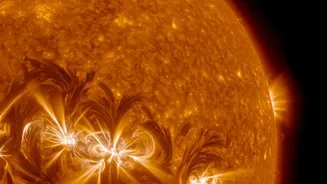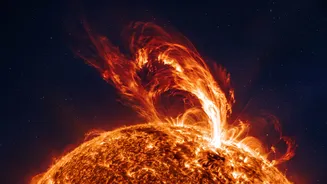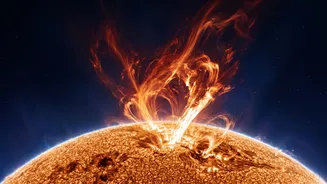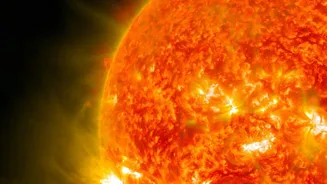



In a remarkable display of international scientific synergy, India's Aditya-L1 solar observatory and the European Space Agency's Proba-3 mission have teamed up, offering an unprecedented view into the Sun's violent eruptions.
India’s Sentinel in Space
Launched in September 2023,
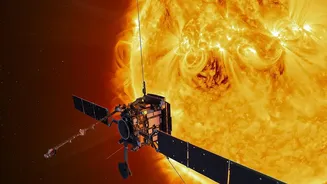
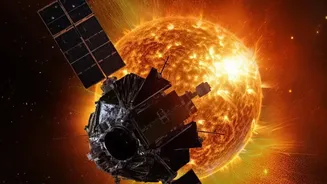
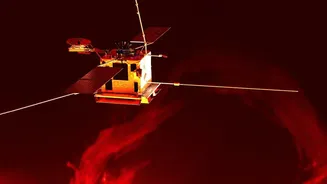
Aditya-L1 is India’s first dedicated mission to observe the Sun. Positioned at the strategic Lagrange point 1 (L1), about 1.5 million kilometres from Earth, it enjoys an uninterrupted view of our star. Among its suite of instruments is the Visible Emission Line Coronagraph (VELC), a sophisticated tool developed by the Indian Institute of Astrophysics. A coronagraph is designed to block the overwhelming glare of the Sun's bright disk, allowing scientists to study the much fainter outer atmosphere, or corona. VELC's special capability is spectroscopy; it can analyse the light from the corona to determine the temperature, velocity, and density of the superheated plasma that makes up these solar structures.
Europe’s Artificial Eclipse
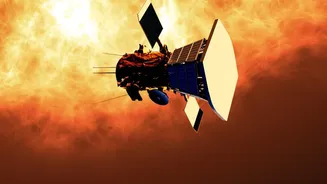
The European Space Agency's (ESA) Proba-3, launched in December 2024 aboard an Indian PSLV rocket, is a mission unlike any other. It is the world's first precision formation-flying mission, consisting of two separate spacecraft flying in a precise alignment 150 metres apart. One spacecraft, the 'Occulter', blocks the Sun's disk, while the other, the 'Coronagraph', observes the Sun's atmosphere in the shadow of its partner. This creates a near-perfect, long-duration artificial solar eclipse in space. This unique setup allows its ASPIICS coronagraph to capture incredibly sharp images of the corona, revealing the shape and movement of solar events with stunning clarity.
A Perfect Cosmic Team-Up
The collaboration between Aditya-L1 and Proba-3 is a case of two highly specialised missions becoming more than the sum of their parts. Observing eruptions close to the Sun has always been a major challenge, as the early evolution of these events is often too faint or rapid to track effectively with older instruments. Aditya-L1’s VELC provides the 'what'—the physical properties like temperature and density of the erupting plasma. Proba-3’s ASPIICS provides the 'where' and 'how'—crisp images of the eruption's structure and movement. By combining spectroscopic data from VELC with imaging data from ASPIICS for the same solar events, scientists can cross-validate their findings and build a far more complete, three-dimensional picture of an eruption as it begins. A recent study published in 'Astronomy & Astrophysics' did just that, analysing two Coronal Mass Ejections (CMEs) captured by both missions in September 2025.
Decoding the Fury of a Solar Eruption
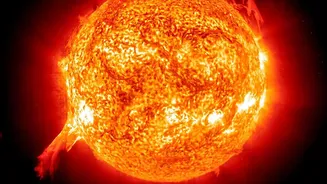
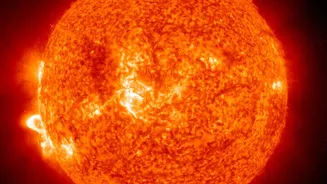
A Coronal Mass Ejection, or CME, is a colossal explosion that hurls billions of tonnes of magnetised plasma from the Sun into space. Measuring the energy of these events is critical. This energy is divided into kinetic (the energy of motion), thermal (heat), and magnetic components. Understanding how this energy is distributed right from the eruption's birth helps scientists refine models of how CMEs are triggered and how they accelerate. The joint observations have allowed researchers to calculate the mass, density, and thermal energy of CMEs with greater confidence than ever before. This data provides crucial new constraints for physical models, helping to solve longstanding questions about the forces that drive these powerful solar phenomena.
Why This Matters for Us on Earth
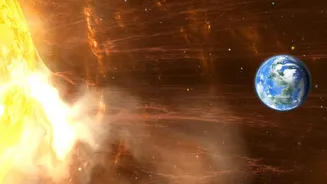
This research isn't just academic. When a CME is aimed at Earth, it can have serious consequences. These solar storms can trigger geomagnetic storms in our planet's magnetic field, disrupting satellite operations, threatening astronauts, interfering with GPS and communication networks, and even straining power grids on the ground. By better understanding the initial energy and structure of a CME, we can improve our 'space weather' forecasts. Knowing how an eruption's shape affects its journey through space can lead to more accurate predictions of its arrival time and potential impact, giving us more time to protect our vital technology‐dependent infrastructure.