
More Than Just Savings
The most obvious benefit of reusing materials is cost. You can often save a significant amount by salvaging items like cabinets, doors, and flooring. But the advantages go far beyond your budget. Environmentally, reusing materials is a massive win. The construction
and demolition industry is a major contributor to landfill waste. Every door you repurpose or cabinet you repaint is one less item in an overflowing landfill and reduces the demand for new raw materials, which in turn cuts down on the energy and carbon emissions associated with manufacturing and transport. Beyond the practical, there's the question of character. Older materials, like solid wood doors or well-built cabinet boxes, often possess a quality and durability that can be hard to find in modern, mass-produced items. They bring a story and a sense of history to a space that new materials simply can't replicate.
Cabinets: The Kitchen's Comeback Kid
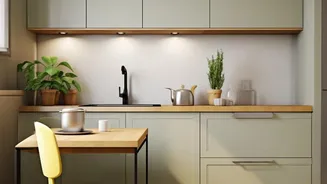
Kitchen cabinets are a prime candidate for reuse. If the boxes are structurally sound, you have a fantastic foundation to work with. A complete transformation can be as simple as a professional paint job and new hardware. This instantly modernises the look without the expense and waste of a full tear-out. For a more significant change, you could replace just the doors while keeping the existing frames. Another option is to reconfigure the layout. Perhaps a set of upper cabinets can be transformed into a base for a new kitchen island or moved to the laundry room for extra storage. Before you discard, assess the quality. Solid wood cabinets are especially worth saving and refinishing.
Doors: Openings to New Ideas
An old door is bursting with potential. As a functional door, a solid wood panel door can be stripped and refinished to become a stunning feature. If it's no longer needed as a door, its second life can be even more creative. A sturdy door can be laid on a base to become a unique dining table or a grand office desk, often with a glass top for a smooth surface. Stood on its side, a vintage door can become a characterful headboard. You can also mount one on a wall in an entryway, add hooks, and create a one-of-a-kind coat rack. Even damaged doors have their uses; a section of a door with interesting panels could be repurposed into wall art or a photo frame.
Structural Beauty: Don't Hide Good Bones
Some of a home's most beautiful features are the ones holding it up. Instead of covering them with plasterboard, a renovation can be an opportunity to expose them. Hidden brick walls can be revealed to add texture and warmth to a room. Ceiling beams can be stripped, cleaned, and sealed to become a rustic or industrial focal point. This approach, often called adaptive reuse, celebrates the building's history and construction. It creates a sense of authenticity and depth. Of course, any work involving structural elements requires careful planning and professional consultation to ensure the building's integrity is not compromised.
A Quick Guide to Reusing
Thinking of incorporating salvaged materials? First, assess what you have. Check for structural soundness, rot, and insect damage. For items like cabinets, check if they are standard sizes, which makes them easier to repurpose. If you're looking for materials, explore architectural salvage yards, online marketplaces, and demolition sites (with permission, of course). When you find a piece, measure it carefully. Remember that while the material cost might be lower, there can be extra labour involved in preparing, refinishing, or fitting a salvaged item. It’s a trade-off, but one that often pays dividends in character and originality.