



The Universe's Greatest Enigma
For decades, we’ve known the universe is expanding. But in the late 1990s, astronomers discovered something startling: that expansion is speeding up. To explain this cosmic acceleration, physicists proposed the existence of an invisible, unknown force
that makes up roughly 68% of the entire cosmos—dark energy. Unlike gravity, which pulls things together, dark energy pushes everything apart. Understanding its nature is paramount, as it will ultimately determine the fate of our universe, whether it ends in a 'Big Rip', a 'Big Crunch', or a slow, cold fade. The problem is, dark energy is incredibly difficult to study directly. So scientists have to get creative, measuring its effects on the history of cosmic expansion.
A New Tool for an Old Mystery
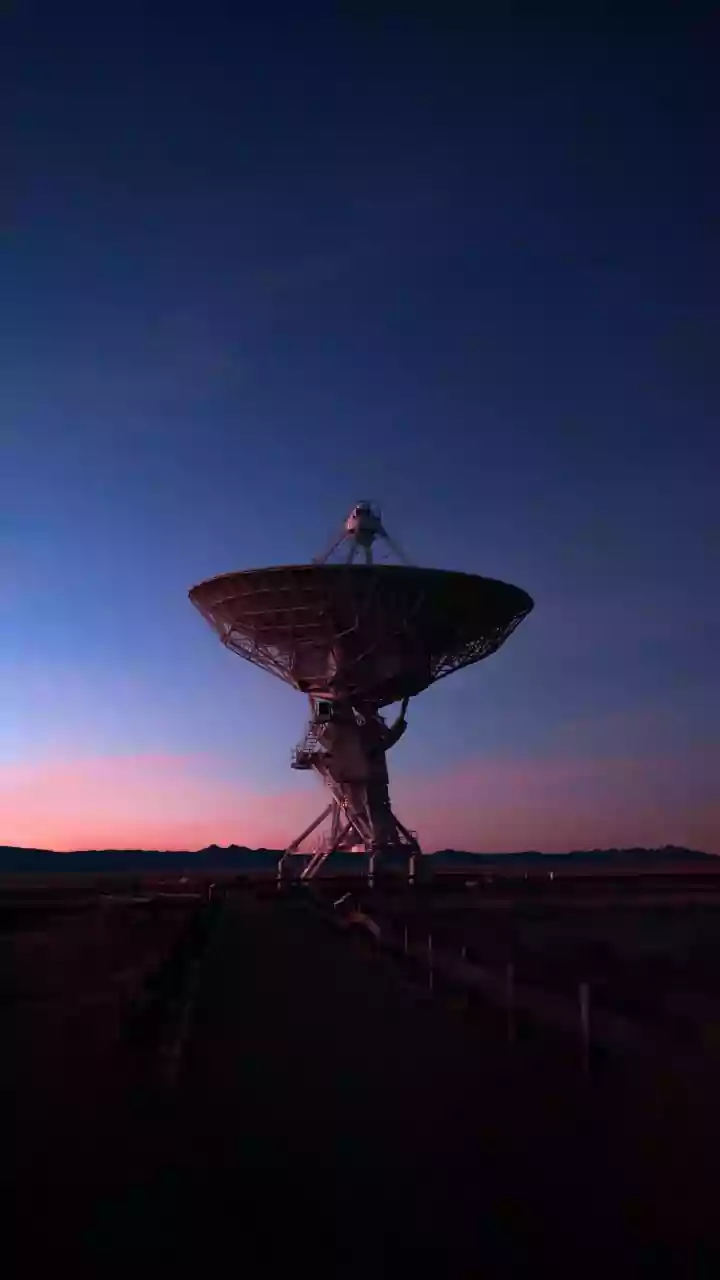
Enter the Canadian Hydrogen Intensity Mapping Experiment, or CHIME. Located in British Columbia, Canada, CHIME is a revolutionary radio telescope that looks nothing like a traditional satellite dish. It consists of four massive, 100-metre-long half-pipe-shaped cylinders with no moving parts. Instead of pointing at specific objects, it scans huge swathes of the sky as the Earth rotates. CHIME was built specifically to create a vast, three-dimensional map of the universe to chart its expansion history with unprecedented precision. And its target isn't stars or galaxies in the traditional sense, but the most abundant and simplest element of all: hydrogen.
Hydrogen as a Cosmic Tracer
Neutral hydrogen gas, which filled the early universe and still clumps together in and around galaxies, constantly emits a faint radio signal at a specific wavelength of 21 centimetres. As the universe expands, this signal gets stretched, and its wavelength becomes longer by the time it reaches us on Earth. By tuning into these redshifted frequencies, CHIME can detect hydrogen from different epochs of cosmic history, effectively looking back in time. This technique, called hydrogen intensity mapping, doesn't try to spot individual galaxies. Instead, it measures the combined, large-scale glow of hydrogen across the sky, creating a low-resolution but immense map of cosmic structure much faster and more affordably than traditional galaxy surveys.
Listening for Ancient Sound Waves
This cosmic map of hydrogen isn't just a picture; it's a tool for measurement. In the very early universe, the cosmos was a hot, dense soup of particles and radiation. The interplay of gravity and pressure created sound waves that rippled through this primordial plasma. When the universe cooled about 380,000 years after the Big Bang, these waves froze in place, leaving a faint, large-scale pattern in how matter is distributed. This pattern is known as Baryon Acoustic Oscillations (BAO). It created a 'standard ruler'—a characteristic distance of about 500 million light-years between clusters of matter. This ancient ruler is still imprinted on the distribution of hydrogen gas today.
Connecting the Map to Dark Energy
By mapping the hydrogen that holds the faint imprint of these BAOs, CHIME can measure the size of this 'standard ruler' at different distances and, therefore, at different times in the universe's history. If we know how big the ruler was originally, we can see how its apparent size has changed over billions of years due to cosmic expansion. By charting these changes with high precision, astronomers can reconstruct the expansion history of the universe. This allows them to see precisely when the expansion started to accelerate and how the strength of dark energy has behaved over time. Recently, the CHIME collaboration announced a major milestone: it successfully detected the hydrogen signal from when the universe was about half its current age using only its own data, proving this powerful technique works.