



A New Golden Age of Astronomy
The latest cosmic portraits come from a fleet of powerful observatories, including the James Webb and Hubble Space Telescopes, which are peeling back layers of the universe that have long been hidden from view. These instruments work in concert, with
each telescope providing a unique perspective. Hubble captures spectacular views in visible and ultraviolet light, while Webb’s infrared capabilities allow it to pierce through cosmic dust and peer further back in time. The result is a richer, more detailed understanding of everything from how stars are born to how galaxies evolve. This international collaboration between NASA and ESA demonstrates how combining data from different instruments can lead to major breakthroughs in our understanding of the cosmos.
Centaurus A: A Galaxy's Turbulent Past
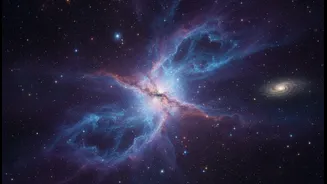
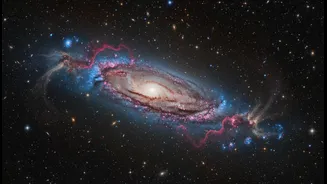
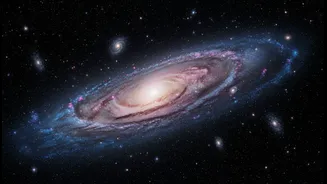
One of the most spectacular new releases is a fresh look at Centaurus A, a galaxy located about 11 million light-years away. To celebrate its fourth year of science operations, the James Webb Space Telescope has revealed this galaxy in stunning new detail. While other telescopes have observed Centaurus A, thick lanes of dust have always obscured its core. Webb’s mid-infrared vision cuts through that dust, exposing a surprising and complex inner structure. Scientists can now see a warped, parallelogram-shaped band of material and strange, wispy dust clouds that pose new questions for astronomers. The image provides a vivid record of the galaxy's violent history, including a collision with another galaxy two billion years ago and the ongoing activity of a supermassive black hole at its center.
LH 95: Where New Stars Sparkle
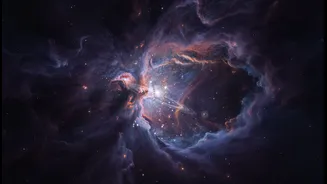
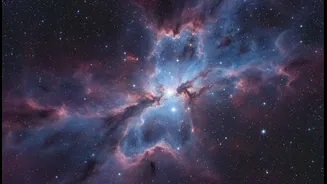
Another breathtaking image comes from the Hubble Space Telescope, showcasing a stellar nursery named LH 95. Located in the Large Magellanic Cloud, a dwarf galaxy that orbits our Milky Way, this region is a bustling hub of star formation. The image reveals approximately 2,500 young, developing stars that have not yet begun nuclear fusion. These 'pre-main-sequence' stars exist alongside massive blue giants, whose intense radiation and powerful stellar winds sculpt the surrounding clouds of glowing red hydrogen gas. By observing multiple generations of stars within the same cosmic neighborhood, astronomers gain crucial insights into the timeline of stellar development.
Mapping the Unseen Universe
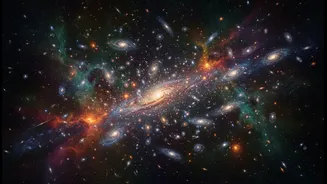
Beyond capturing beautiful individual objects, these telescopes are also undertaking massive surveys to map the large-scale structure of the universe. ESA's Euclid telescope, with contributions from NASA, recently captured an incredibly detailed image of the Milky Way's core, packed with over 60 million stars. One of Euclid's primary missions is to investigate the mysterious phenomena of dark matter and dark energy, which together are thought to make up 95% of the cosmos. By observing billions of galaxies, some so distant their light has traveled for 10 billion years to reach us, Euclid will create the most extensive 3D map of the universe ever made. These observations will help scientists understand how dark matter has shaped the evolution of galaxies and the cosmic web—the vast scaffolding of the universe itself.