

A Gold Rush for Water
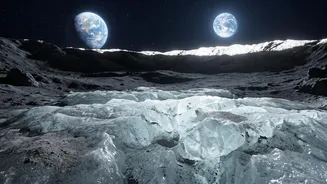
The focus of this new space race is the Moon's South Pole, a region of extreme contrasts. While parts of it experience near-permanent sunlight, perfect for solar power, other areas are home to permanently shadowed craters. These craters haven't seen the sun in
billions of years, making them some of the coldest places in our solar system. This deep freeze has acted as a trap, preserving water ice that was likely delivered by comets and asteroids long ago. Orbiting missions have confirmed the presence of hydrogen, a key component of water, in these dark, cold traps. For NASA's Artemis program, which aims to establish a sustainable human presence on the Moon, this ice is a game-changing local resource.
The Tools for the Job
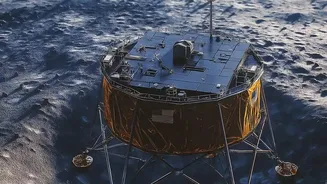
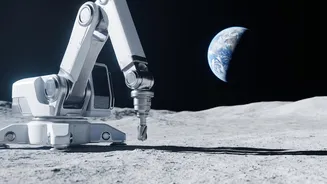
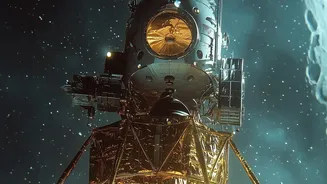
To get to the ice, NASA is relying on a new generation of robotic prospectors. A key early technology demonstration was the Polar Resources Ice Mining Experiment-1, or PRIME-1. This suite of instruments was sent to the Moon to test the very technologies needed for a larger-scale mission. It featured a drill called TRIDENT (The Regolith and Ice Drill for Exploring New Terrain) and a mass spectrometer known as MSOLO (Mass Spectrometer Observing Lunar Operations). The idea was to drill into the lunar soil, or regolith, bring samples to the surface, and analyze them on the spot for water and other volatile compounds. These early tests provide crucial data on the engineering and techniques needed to operate in the harsh lunar environment.
Drill, Heat, and Capture
The fundamental plan for extracting the water is a multi-step process. First, a robotic system, like the one tested by PRIME-1, will drill into the ice-rich regolith. The TRIDENT drill was designed to be robust, capable of boring up to a meter deep into the unknown lunar subsurface. Once the icy soil is accessed, the next step involves heating it. In the vacuum of space, frozen water doesn't melt into a liquid; it sublimates directly into a gas. The plan is to heat the excavated material in a contained chamber, capturing the resulting water vapor. This vapor can then be channeled into a freezing-cold storage tank, where it will condense and refreeze into pure, clean ice, ready for astronauts to use.
More Than Just a Drink
While providing drinking water is a vital function, the potential uses for lunar water extend far beyond life support. Through a process called electrolysis, water (H₂O) can be split into its component elements: hydrogen and oxygen. Oxygen is obviously essential for breathable air in habitats. Both hydrogen and oxygen are also powerful rocket propellants. This means the Moon could one day become a refueling station for missions venturing deeper into the solar system, such as to Mars. Instead of launching massive, fully-fueled rockets from Earth, spacecraft could launch with just enough fuel to get to the Moon, top up their tanks, and then continue their journey. This dramatically reduces the cost and complexity of deep space exploration.
The Road Ahead
The road to large-scale water extraction is challenging. The technology must be proven to work reliably for long durations in one of the harshest environments imaginable. Following initial tests like PRIME-1, NASA's next major step involves the Volatiles Investigating Polar Exploration Rover (VIPER). After the initial project was cancelled and then revived, VIPER is planned to be a golf-cart-sized rover that will roam the south pole for about 100 days. It will create the first-ever resource maps of the Moon, charting the location and concentration of water ice to help determine the most promising sites for future Artemis astronaut landings and resource extraction plants. International collaboration, such as a joint mission with Japan and India's space agencies, will also help map these resources. This methodical, robotic-led approach is paving the way for a future where living and working on the Moon is not science fiction, but a sustainable reality.