
Earth's Mysterious Twin
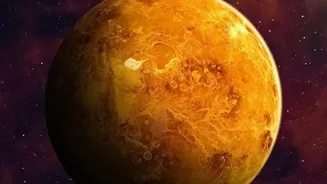
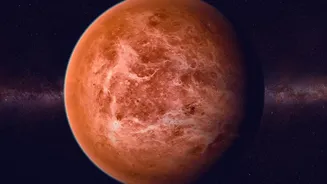
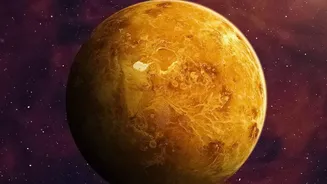
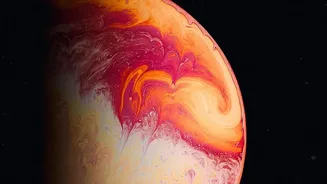
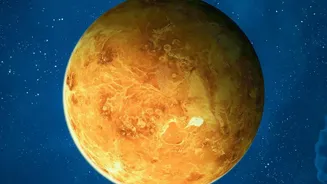
Venus and Earth are similar in size, mass, and origin, yet they could not be more different today. While Earth blossomed with life, Venus became a hellscape. Its surface is hot enough to melt lead, and the atmospheric pressure is over 90 times that of
Earth's at sea level. These hostile conditions are trapped beneath a thick, unbroken blanket of sulfuric acid clouds that perpetually shroud the planet, reflecting sunlight and hiding the surface from direct view. Understanding why our planetary neighbour took such a drastically different evolutionary path is one of the biggest puzzles in planetary science, and a key reason scientists are so eager to look beneath its clouds. The answer could hold crucial lessons about how planetary climates evolve, including our own.
Secrets in the Sulfuric Clouds
The dense clouds of Venus are not just a veil; they are a laboratory of bizarre chemistry. For decades, scientists have been mystified by strange, dark patches that absorb ultraviolet (UV) light, hinting at an unknown chemical component they call the 'unknown UV absorber'. More recently, the tentative detection of phosphine gas—a compound that on Earth is associated with living organisms—has fueled intense debate and speculation. While not proof of life, its potential presence demands further investigation. Another major puzzle is the planet's 'super-rotation,' where the atmosphere whips around the planet in just four Earth days, far faster than the planet's own sluggish 243-day rotation. Shukrayaan aims to tackle these questions head-on.
Enter Shukrayaan: India's Next Big Leap
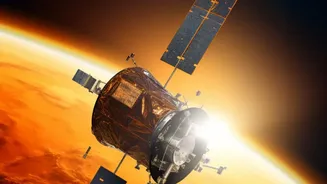
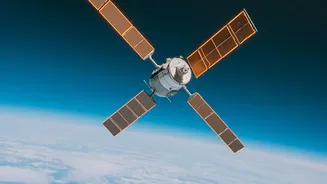
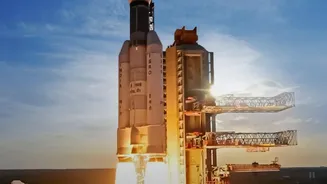
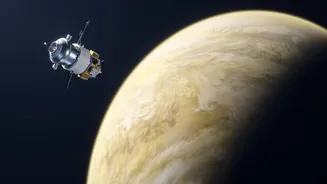
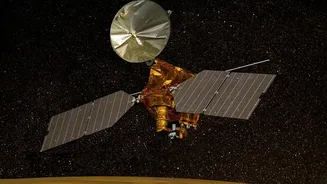
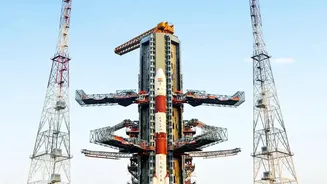
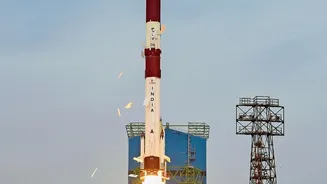
Following the monumental successes of Chandrayaan and the Mars Orbiter Mission (Mangalyaan), the Indian Space Research Organisation (ISRO) is setting its sights on Venus. The Venus Orbiter Mission, unofficially known as Shukrayaan, is India's first dedicated mission to our nearest planetary neighbour. Formally approved by the government in September 2024 with a launch planned for March 2028, the mission represents India's growing ambitions in deep space exploration. The spacecraft, launched aboard the powerful LVM-3 rocket, will journey for 112 days to enter a highly elliptical orbit around Venus. Over several months, it will use a technique called aerobraking, using the friction of the upper atmosphere to gradually lower its orbit for scientific operations.
A Toolkit for Unlocking Mysteries
Shukrayaan will carry a suite of 19 sophisticated instruments, a mix of Indian-made technology and international collaborations with agencies from Sweden, Russia, and Germany. A high-resolution Synthetic Aperture Radar (SAR) will pierce through the dense clouds to map the surface in unprecedented detail, searching for signs of active volcanoes. It will also feature the first-ever ground-penetrating radar to be used at Venus, which will probe beneath the surface to study its geological history. To investigate the atmospheric mysteries, instruments like the Venus Infrared Atmospheric Gases Linker (VIRAL) will analyze the chemical composition of the clouds, searching for clues about phosphine and other trace gases. Meanwhile, the Venusian Neutrals Analyzer (VNA), a contribution from Sweden, will study how the solar wind interacts with the planet's upper atmosphere.
Why This Mission Matters for India
Shukrayaan is more than just a scientific expedition; it's a statement of India's prowess as a global space power. Building on the cost-effective model of its previous interplanetary missions, ISRO is proving it can conduct high-impact science on a competitive budget. The mission will provide a treasure trove of data not just for Indian scientists, but for the global community, complementing upcoming missions from NASA and ESA. Furthermore, studying the runaway greenhouse effect on Venus provides a stark, real-world laboratory for understanding climate change dynamics, offering invaluable insights for protecting our own planet. This ambitious project reinforces India’s capability in designing and executing complex deep-space missions and inspires a new generation of scientists and engineers.