





The Flying Sikh's Golden Sprint
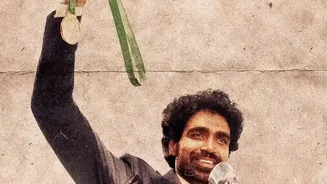
In 1958, at the British Empire and Commonwealth Games in Cardiff, a relatively unknown sprinter from India stepped onto the track. His name was Milkha Singh. At that point, independent India had never won a gold medal at the Games. Competing in the 440-yard
race, Singh was up against formidable opponents, including the world-record holder Malcolm Spence of South Africa. Urged on by his American coach, Singh ran the race of his life. He pushed ahead with incredible speed, holding a lead for the first 350 yards. In the final stretch, as Spence began to close the gap, Milkha dug deep and powered through, winning by a mere 0.3 seconds. He clocked in at 46.6 seconds, securing India's first-ever Commonwealth Games gold. The victory was so significant that then-Prime Minister Jawaharlal Nehru declared a national holiday at Singh's request. It was a moment that announced India's arrival on the world athletics stage and gave the nation a new hero, the 'Flying Sikh'.
The Golden Goal That Inspired a Film
The 2002 Commonwealth Games in Manchester delivered one of Indian sport's greatest underdog stories. The Indian women's hockey team, ranked 17th at the time, was not expected to make a deep run. Yet, they defied all expectations. The team's journey to the final was dramatic, including a thrilling 4-3 comeback win in extra time against South Africa after being 0-3 down. In the final, they faced the host nation, England, a team ranked 5th in the world. The match was a tense affair, ending 2-2 in normal time. In the nail-biting extra time, Mamta Kharab scored the 'golden goal' to give India a historic 3-2 victory. It remains the Indian women's hockey team's only Commonwealth gold to date. The team's incredible run, spearheaded by coach Mir Ranjan Negi, captured the nation's heart and later inspired the blockbuster Bollywood film, 'Chak De! India'.
The Wrestler Who Broke the Barrier
When New Delhi hosted the Commonwealth Games in 2010, the nation was eager for homegrown heroes. Geeta Phogat delivered one of the most resonant victories of the Games. Hailing from Haryana, a state with deeply patriarchal norms, her journey in the male-dominated sport of wrestling was revolutionary. In the 55kg freestyle final, Phogat faced Australia's Emily Bensted. With the home crowd roaring, she put on a dominant performance, winning the bout comfortably to claim gold. This was not just any medal; it was India's first-ever Commonwealth Games gold in women's wrestling. Phogat's win was a watershed moment, breaking glass ceilings and proving that Indian women could excel in combat sports. Her success, along with that of her sisters, inspired countless young girls to take up wrestling and was famously depicted in the film 'Dangal'.
The Javelin That Conquered the Commonwealth
By the 2018 Gold Coast Commonwealth Games, Neeraj Chopra was already a junior world champion, but he was yet to claim a major senior title. The 20-year-old entered the javelin throw event as a top contender and lived up to the hype with remarkable composure. In the final, his very first throw of 85.50m put him in the lead, a position he would not relinquish. He secured the gold with a season-best throw of 86.47m. So dominant was his performance that even his worst throw of the final was better than the silver medallist's best effort. With this victory, Neeraj Chopra became the first Indian athlete to win a gold medal in the javelin throw at the Commonwealth Games. This win was a crucial stepping stone in his burgeoning career, foreshadowing the even greater heights he would reach, including his historic Olympic gold in Tokyo.