The Ringless Wonder
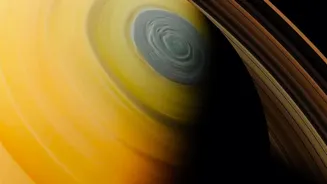
In our solar system, having rings is not as exclusive as one might think. The gas giants—Jupiter, Saturn, Uranus, and Neptune—all have ring systems, though none are as spectacular as Saturn's. These rings are composed of countless particles of ice and rock,
leftovers from moons shattered by gravity or debris from the solar system's formation. Given this, the question arises: why is Earth, a significant planetary body, so conspicuously bare? The answer lies not in a single factor, but in a combination of powerful forces that create a unique and surprisingly hostile environment for any potential ring material.
Earth's Invisible Forcefield
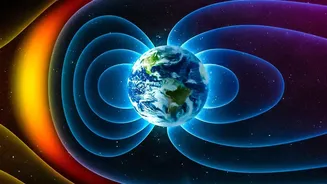
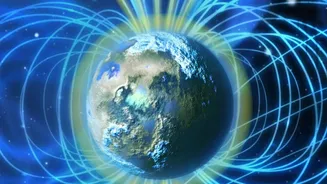
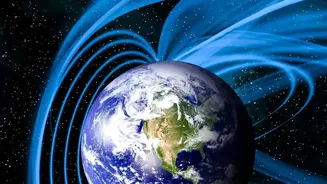
Surrounding our planet are the Van Allen radiation belts, two doughnut-shaped zones filled with highly energetic charged particles, primarily electrons and protons. Held in place by Earth's magnetic field, these belts act as a natural shield, trapping particles from the solar wind and cosmic rays. First discovered in 1958, these belts are a dynamic feature of our planet's magnetosphere. While they protect life on the surface from harmful radiation, they also play a crucial role in maintaining the emptiness of nearby space. This isn't a passive barrier; it's an active system that cleanses its surroundings.
The Ultimate Cosmic Cleaner
The headline's 'radiation shielding' is key. The intense radiation within the Van Allen belts acts as an 'impenetrable barrier' for ultra-fast electrons. But how does this affect dust? Research suggests a phenomenon known as 'plasmaspheric hiss'—a type of very low-frequency electromagnetic wave—plays a significant role. These waves effectively scatter incoming particles, including potential ring-forming dust. This scattering causes the particles to lose momentum and fall into the upper atmosphere, where they burn up. The Van Allen belts, therefore, don't just trap particles; they create a 'wall' that deflects and helps eliminate debris that might otherwise settle into orbit.
A Push from the Sun
Earth's magnetic field isn't working alone. The Sun itself exerts a constant, gentle pressure through its light, known as solar radiation pressure. While this force is incredibly weak on large objects, it has a significant effect on tiny particles like dust. Over long periods, this constant outward push acts like a cosmic broom, sweeping fine particles away from the Sun. For a planet like Earth, which is relatively close to the Sun, this effect is much stronger than for distant planets like Saturn. Any dust that wasn't immediately cleared by the radiation belts would still face this inexorable push, preventing it from accumulating into a stable ring structure.
The Moon and the Frost Line
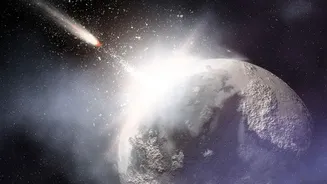
Two other factors contribute to Earth's ringless status. Firstly, our large Moon. The leading theory of the Moon's formation suggests it coalesced from a massive ring of debris created when a Mars-sized object collided with early Earth. In a way, Earth 'used up' its primary ring-forming material to create its lunar companion. Secondly, we orbit inside the solar system's 'frost line'. This is the point beyond which water ice can remain stable without sublimating away due to the Sun's heat. Saturn's famous rings are mostly water ice. Any icy material that might have formed a ring around Earth would have long since been vaporised by solar radiation, leaving only rock and dust to be cleared by the other forces at play.