





An Unexpected Signal From Deep Space
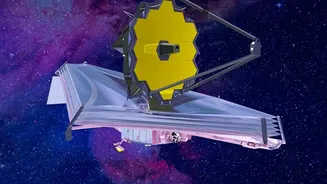
In the vast darkness between stars, astronomers using the powerful James Webb Space Telescope (JWST) have detected the chemical fingerprint of methane in the atmosphere of a distant exoplanet. While finding methane isn't new, its presence on this specific
type of world—a 'warm Neptune'—is a genuine puzzle. These planets are not considered prime candidates for hosting life, making the detection both unexpected and scientifically thrilling. The discovery challenges long-held theories about planetary chemistry and pushes scientists to reconsider where the building blocks for life might be found. It’s a finding that doesn't provide easy answers but instead opens up a fascinating new chapter in our exploration of the cosmos.
What is a Warm Neptune?
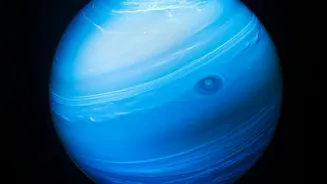
Imagine a planet similar in size to our own Neptune but nestled much closer to its host star, resulting in significantly warmer temperatures. These are known as 'warm Neptunes'. Unlike the icy giants at the edge of our solar system, these worlds are blasted with stellar radiation. They are gas giants, composed primarily of hydrogen and helium, and lack a solid surface like Earth's. For this reason, they have never been high on the list of potentially habitable worlds. The conditions are extreme, and their atmospheres were expected to follow predictable chemical rules based on their temperature and proximity to their star. This recent discovery, however, shows that our assumptions might have been too simple.
The Methane Mystery
Methane (CH4) is a molecule that gets astrobiologists excited. On Earth, the vast majority of atmospheric methane is produced by living organisms, from microbes in wetlands to digestive processes in animals. Because of this, it's considered a potential 'biosignature'—a chemical sign of life. However, methane can also be produced by non-biological processes, such as volcanic activity. The key is context. In a warm Neptune's atmosphere, methane should be chemically unstable. The intense radiation from the nearby star is expected to break it down quickly. To find a stable presence of methane implies something is constantly replenishing it. This is the heart of the mystery: what is producing the methane on a world where our current models say it shouldn't last?
Challenging Planetary Science
The detection of methane on a warm Neptune suggests that the atmospheres of these planets are far more complex than previously thought. There are a few possibilities, each with profound implications. One is that there's an unknown chemical pathway creating methane under these specific high-temperature conditions. If so, our models of atmospheric chemistry for gas giants need a major update. Another, more speculative idea, involves the planet's interior. Perhaps unforeseen geological activity deep within the planet is releasing the gas into the atmosphere. A recent JWST study of a mini-Neptune, for example, found its heavy atmosphere suggested it formed much farther from its star before migrating inward, completely changing its history. This discovery forces scientists back to the drawing board to explore processes they hadn't considered for this class of planet.
Redefining the Search for Habitability
To be clear, scientists are not suggesting there is life floating in the clouds of this gas giant. Instead, this discovery broadens the definition of a 'habitable' environment. The presence of methane, a key ingredient in organic chemistry, in such an unexpected place suggests that the raw materials for life might be more widespread than we know. It raises new questions: could a large, rocky moon orbiting this warm Neptune have conditions suitable for life, with the planet’s methane playing a role in its atmosphere? Does this mean other 'unlikely' planets might harbour complex chemistry? This finding encourages a more open-minded approach, pushing researchers to study a wider variety of worlds. The focus is shifting from just finding an Earth-twin to understanding the full diversity of planetary environments where life's precursors might arise.