






Understanding Zone 2 Cardio
Zone 2 refers to exercising at a steady, moderate intensity, typically between 60% and 70% of your maximum heart rate. This is the level of effort where your body becomes incredibly efficient at burning fat for fuel and building mitochondrial density,
which is key for endurance. Forget gasping for air; the easiest way to know you're in Zone 2 is the 'talk test'. You should be able to hold a full conversation without struggling for breath. If you can sing, you’re likely in Zone 1. If you can only get out a few words, you’ve pushed into Zone 3 or higher. It’s a sustainable pace that you should be able to hold for an extended period, making it a powerful tool for building a deep cardiovascular foundation with relatively low physical strain.
Hack 1: Perfect Your Rowing Form
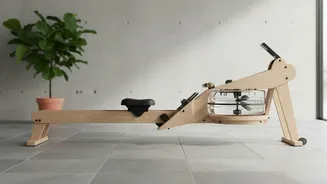
The most important 'hack' isn't a shortcut—it's mastering the fundamentals to prevent injury. An incorrect rowing stroke is a fast track to knee and back pain. The stroke has a distinct sequence: legs, body, arms on the way back, and arms, body, legs on the way forward. A common mistake that strains the knees is bending them too early on the recovery, before your hands are past them. Another is over-compressing at the 'catch' phase, where your shins go far beyond vertical and your knees are pushed past your ankles. This puts unnecessary pressure on the knee joint. Focus on a controlled slide forward, stopping when your shins are roughly perpendicular to the ground to keep the joint safe.
Hack 2: Dial In Your Machine Setup
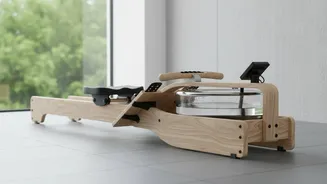
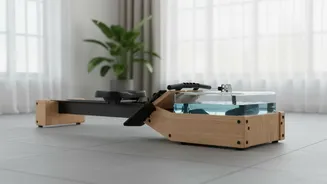
A proper setup is crucial for protecting your joints. The two key adjustments on most rowing machines are the footplate height and the damper setting. Your foot straps should be positioned so the strap crosses the widest part of your foot, often near the balls of your feet. If the footplates are too high, it can lead to excessive knee flexion and discomfort. If you're unsure, try a lower setting first. The damper setting, often mistaken for resistance, controls how much air enters the flywheel. For Zone 2, a lower damper setting (typically 3-5) is ideal. This simulates a sleeker, faster boat and encourages better technique without placing heavy, unnecessary load on your joints at the beginning of the stroke.
Hack 3: Train by Heart Rate, Not Speed
Zone 2 is all about maintaining a specific physiological state, not hitting a certain speed or split time on the monitor. Your goal is to keep your heart rate within that 60-70% range. To calculate this, a simple method is to subtract your age from 220 to get an estimated maximum heart rate (MHR), then take 60% and 70% of that number. For example, a 40-year-old would have an estimated MHR of 180, putting their Zone 2 range between 108 and 126 beats per minute. Use a chest strap for the most accurate reading, though a smartwatch is also effective for steady-state cardio. Focus on staying in this zone, even if it means rowing at a pace that feels surprisingly slow. The benefits come from sustained time in the zone, not raw power.
Hack 4: Avoid Hyperextension and Rushing
Two other common technical flaws can lead to joint strain. The first is locking out or hyperextending your knees at the 'finish' of the stroke. Your legs should be straight but not locked, maintaining a slight softness in the joint to keep the muscles engaged and protect the knee. The second mistake is rushing the 'recovery' phase as you slide forward. The recovery should be a controlled and patient movement, taking about twice as long as the 'drive' phase where you push back. Rushing the slide disrupts your rhythm, spikes your heart rate out of Zone 2, and eliminates the brief period of rest your body needs between strokes, leading to faster fatigue.