

The Gentle Push of Sunlight
The magic behind solar sailing is a phenomenon called solar radiation pressure. Sunlight is made of countless particles called photons. While individual photons have no mass, they have momentum. When a photon strikes a surface, it transfers that momentum,
giving the surface a tiny push. If the surface is reflective, like a mirror, the photon bounces off, imparting a second, slightly stronger push. In the vacuum of space, this continuous, gentle force from billions of photons can build up over time, constantly accelerating a spacecraft. Unlike chemical rockets, which provide a powerful but brief burst of thrust, solar sails offer a slow but relentless acceleration that can eventually lead to incredible speeds.
Building a Sail for the Cosmos
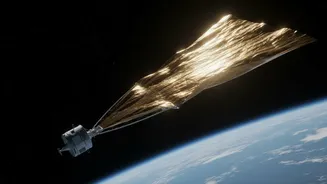
To catch enough sunlight to be effective, a solar sail must be enormous in area but incredibly thin and lightweight. Typical sails are made from materials like Mylar or other advanced polymers, coated with a layer of highly reflective aluminum. Some are just a few microns thick—thinner than a human hair. NASA's Advanced Composite Solar Sail System (ACS3), launched in 2024, is testing new booms made of lightweight composite materials to unfurl and support a sail about the size of a small apartment. These new booms are designed to be 75% lighter and more stable in space than previous metallic versions, paving the way for future sails as large as a basketball court or even half a soccer field.
A Marathon, Not a Sprint
Solar sails are not designed for launching from Earth's surface; a conventional rocket is needed to carry the folded sail into orbit. Once in space, however, the sail unfurls and begins its work. The initial thrust is minuscule—on a sail measuring 800 by 800 meters, the force is roughly equivalent to the weight of a paperclip. But because this push is constant and the sun provides an endless supply of fuel, a solar sail craft can accelerate indefinitely. By tacking—angling the sail relative to the sun, much like a sailboat in the wind—the spacecraft can control its direction and navigate complex orbital paths. This makes solar sails ideal for long-duration, low-cost missions, such as moving satellites, monitoring space weather, or exploring near-Earth asteroids.
Pioneering Missions Prove the Concept
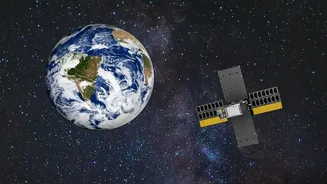
The theory of solar sailing has been proven by several pioneering missions. In 2010, Japan's IKAROS became the first spacecraft to successfully demonstrate controlled solar sailing in interplanetary space. More recently, The Planetary Society's crowdfunded LightSail 2 mission, which operated from 2019 to 2022, used its sail to successfully raise its orbit around Earth, proving the technology is viable for small, low-cost CubeSats. NASA is building on these successes with missions like ACS3, which is testing new deployable boom technology. Data from these missions will inform the design of larger, more ambitious solar sails for future scientific endeavors.
The Future of Interstellar Travel?
The potential applications for solar sails are vast. They could be used to position early-warning systems for solar storms closer to the sun, giving us more time to protect our power grids and communication satellites. They also offer a promising method for deorbiting old satellites, helping to clean up space junk. Looking further ahead, the technology could open the door to faster interplanetary travel, cutting journeys to the outer solar system from years to months. For truly interstellar journeys, scientists envision enormous sails propelled not just by the sun, but by powerful, focused laser beams from Earth. This would provide a much stronger push, potentially accelerating a probe to a fraction of the speed of light and reaching for the stars.