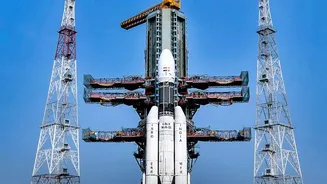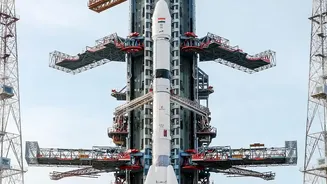




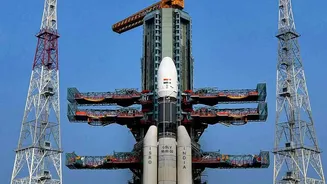
The Ultimate Safety Net: Crew Escape System
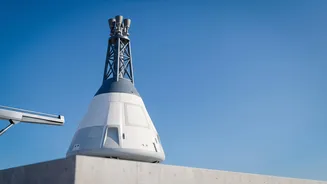
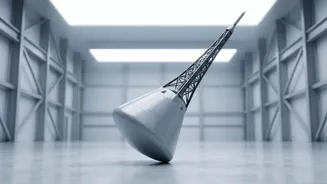
Human spaceflight is inherently dangerous, especially during the launch phase when the rocket is under immense stress. To safeguard the astronauts, ISRO has developed the Crew Escape System (CES), a critical safety mechanism designed to act in milliseconds
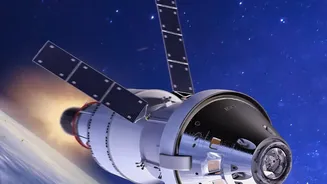
if an emergency strikes. Positioned as a tower-like structure atop the crew module, the CES is essentially a powerful eject button for the entire astronaut capsule. Its sole purpose is to pull the Crew Module away from a failing rocket with immense force, moving the crew to a safe distance from any potential explosion or malfunction on the launchpad or during ascent. This 'puller' design, similar to the systems used in the Apollo and Soyuz missions, uses a cluster of quick-acting, high-burn-rate solid motors to out-accelerate the launch vehicle itself.
Scenario One: Trouble on the Launchpad
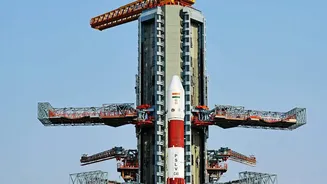
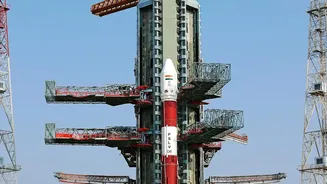
An emergency doesn't always happen mid-flight. A critical failure can occur seconds before or during ignition, while the rocket is still on the launchpad. This is where the Pad Abort Test (PAT) comes into play. ISRO successfully demonstrated this capability in a 2018 test. In such a scenario, the CES would fire its powerful solid motors to lift the Crew Module vertically and then steer it away from the launch complex. The system is designed to carry the module to a sufficient altitude where its parachute system can safely deploy, ensuring a gentle splashdown in the nearby sea. This entire sequence, from abort trigger to splashdown, happens in just a few minutes, providing a crucial escape route from a ground-level catastrophe.
Scenario Two: Mid-Flight Emergencies
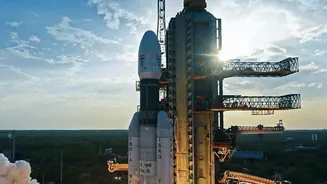
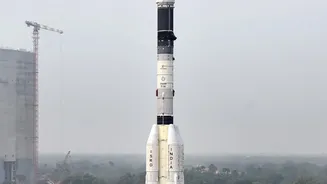
The ascent phase is another critical window. As the rocket gains speed and altitude, it faces peak aerodynamic pressure, a point known as 'Max-Q'. An anomaly here requires a different kind of abort. ISRO has rigorously tested this through its Test Vehicle Abort Missions, such as TV-D1. In these tests, a dedicated single-stage liquid rocket carried a boilerplate Crew Module to a specific altitude and speed. An abort was then deliberately triggered, simulating a launch vehicle failure. The CES motors fired, pulling the module away at transonic speeds. After reaching a safe distance and altitude, the escape tower jettisons, and the Crew Module begins its own descent sequence, deploying a series of parachutes to slow down for a safe landing in the Bay of Bengal.
Proven Through Rigorous Testing
Confidence in the abort system is built through relentless testing, not just theory. The Gaganyaan program includes a series of precursor missions designed to validate every component of crew safety. The Pad Abort Test proved the system works from a standstill. The TV-D1 mission demonstrated a successful in-flight abort under high-stress atmospheric conditions, validating the entire sequence from separation to recovery by the Indian Navy. ISRO has also conducted integrated air-drop tests, releasing a full-scale module from a helicopter to test the complex 10-parachute deployment system that ensures a soft landing. Further tests will continue to validate the system's performance at different altitudes and conditions, ensuring the Crew Escape System is reliable across the entire ascent phase before any astronaut boards the rocket.
An Automated Guardian Angel
In a fast-moving crisis, human reaction time may not be enough. That's why the Gaganyaan's safety is underpinned by an autonomous brain: the Integrated Vehicle Health Management (IVHM) system. This system continuously monitors thousands of parameters on the launch vehicle in real time, from engine thrust to structural integrity. If it detects a critical, off-nominal condition, the IVHM is programmed to automatically trigger the Crew Escape System in fractions of a second. This automated response ensures the escape sequence is initiated as early as possible, maximising the chances of crew survival even before the astronauts themselves might be aware of the danger.